humanizer
EssayDone Humanizer review: three changes that reversed the meaning
The first Basic 4.5 output was easy to obtain, but changed the staff's sentiment and reversed parts of the opening-hours discussion. The result needs a factual repair, not just polishing.
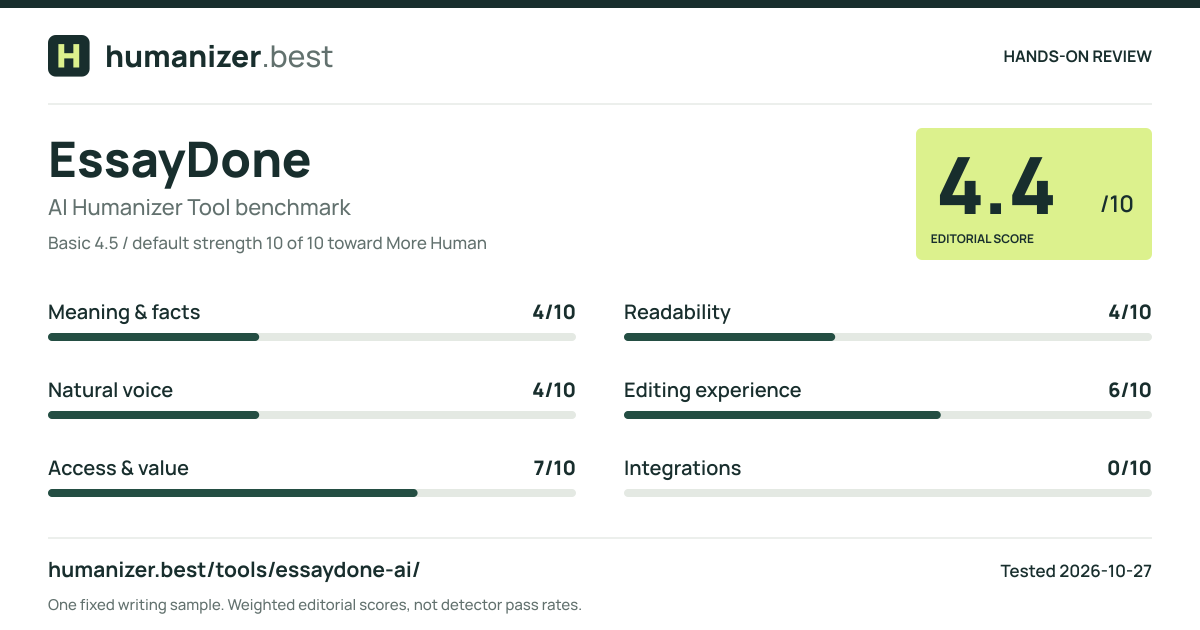
The screenshots, complete input and output, feature table and scoring breakdown are on the separate tool profile.
View EssayDone tool details and evidenceEssayDone's free Humanizer completed our test without an account, but its first draft changed the meaning in three conspicuous places. Staff who had reported fewer interruptions were described as complaining about them. Longer evenings became fewer evenings. A warning about opening on fewer days became a sentence about closing on fewer days. These are editing problems that a favorable detector label would not resolve.
We used Basic 4.5 on October 27, 2026 and kept the first complete output. The EssayDone tool profile shows the homepage, source and result screenshots, full text comparison and individual scores.
The test setup
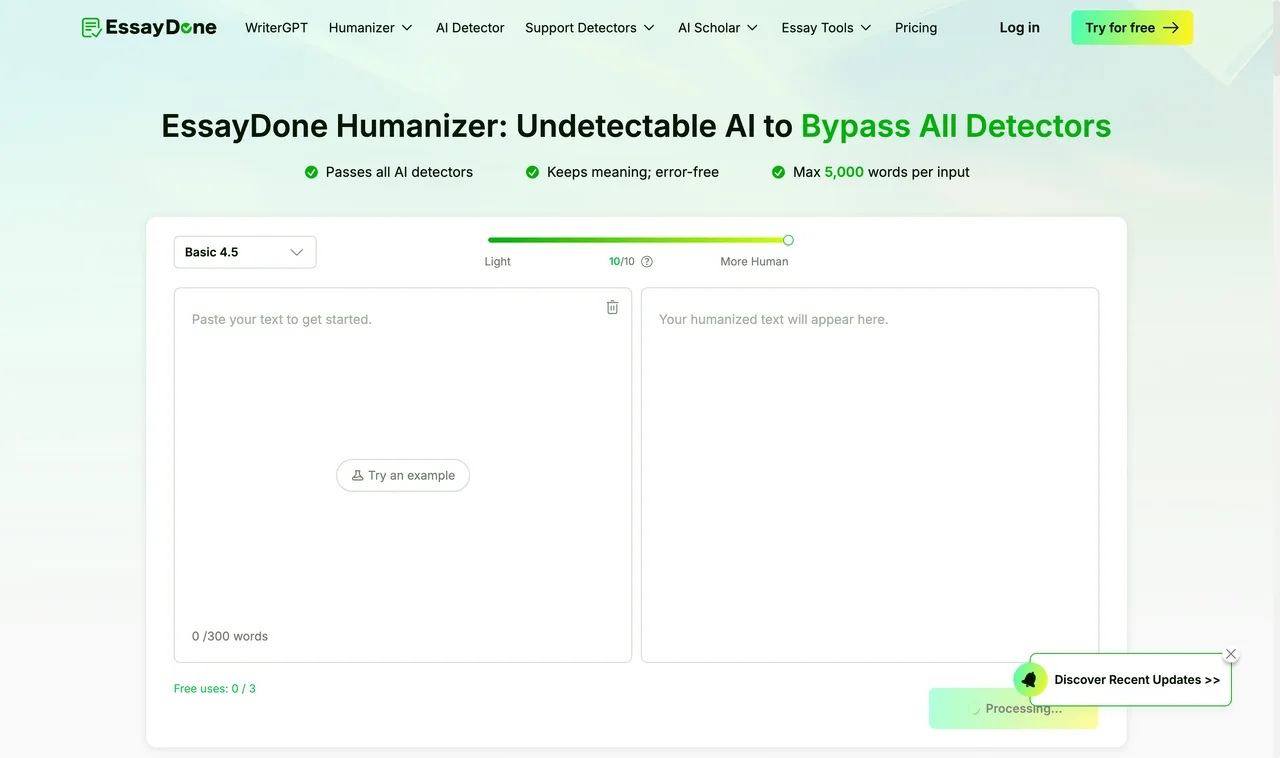
The editor accepted our unchanged 93-word paragraph. It displayed a 300-word input limit and counted the sample as 94 words, reflecting the site's own tokenization. Basic 4.5 was selected, and the strength control was at its default 10 of 10 toward More Human. We did not tune the slider after seeing the result.
The page's free-use counter showed one use out of three after the run. There was no registration or payment step before the complete output appeared. This is useful access for a reader who wants to inspect the tool before choosing a plan, and it earns the product a Free tag for this benchmark.
We retained the first draft rather than choosing a more favorable version. The result interface showed one available variant during this free test. That observation is separate from the product's broader claim that it can generate several drafts and let users swap sentences between them.
EssayDone's usage advice recommends longer text for some detector-related outcomes. Our short sample tests whether the rewrite preserves a report's meaning; it cannot establish how a detector would classify a longer essay.
What the original report says
A local library tries a four-day schedule for six weeks. It keeps the same 40 weekly opening hours by closing Wednesday and extending Monday and Thursday evenings. Attendance rises from 1,200 to 1,320 visits per week, while Wednesday visitors have to change their plans.
Staff report fewer interruptions, but no productivity measurement is taken. The paragraph suggests that longer evenings may help daytime workers and warns that this does not prove all libraries should open fewer days. Before a permanent change, the team plans a survey, a cost comparison and another trial in winter.
This is a deliberately qualified report. It contains a promising attendance observation, a visitor inconvenience and a clear limit on the staff evidence. The ending calls for more information before a general conclusion. A faithful humanizer should keep that balance even if it changes every sentence.
The sample is fictional and AI-generated for this comparison. There are no outside facts for the tool to research, and no instruction to add color or explanation. When a rewrite changes a claim, we can compare it directly with the source instead of debating whether an invented detail might happen to be true somewhere else.
The staff became dissatisfied without evidence
The first significant change concerns the staff. The source uses a neutral reporting verb. EssayDone substitutes “complained” while describing fewer interruptions. That makes the staff sound dissatisfied, even though the original does not tell us how they felt about the change.
The sentence is also awkward on its own terms. Complaining about reduced interruptions is not the ordinary implication of reporting them. A reader may pause to infer what the staff were unhappy about, but the source supplies no answer. The rewrite has introduced a puzzle rather than clarified the report.
The changed verb gives staff an attitude the source never described. In a workplace update, a reader could take it as evidence of dissatisfaction with the trial. That is a factual problem as well as an awkward phrase.
A repair would restore the neutral verb "reported". The rest of the sentence can keep its explicit statement that productivity was not measured. That qualification survived even though the staff's supposed complaint did not come from the source.
Longer evenings became fewer evenings
The next error appears in the discussion of who might benefit. The original concerns extending evening access. The output instead refers to “Less evenings”. That is grammatically awkward and changes the comparison from evening duration to the number of evenings.
The difference is central to the trial. The library is keeping the same weekly opening hours while redistributing them. Longer evenings might suit people who cannot visit during daytime hours. Fewer evenings would describe a different service change and could have the opposite practical effect.
Someone checking only the phrase about daytime workers might miss the reversal. The group remains recognizable, but the benefit being offered to them has changed. This is why our factual check follows the relationship between details rather than simply looking for the same nouns.
The opening still says Monday and Thursday evenings were extended, so "Less evenings" also conflicts with the draft's own description. Checking one sentence at a time would not be enough; the final paragraph has to describe a consistent schedule.
Opening fewer days and closing fewer days are different
The same sentence then changes the general warning. The source says the experiment does not prove that every library should open on fewer days. The output talks about every library closing on fewer days. Those are different propositions.
Opening fewer days means reducing the number of days with service. Closing fewer days means reducing the number of days without service. In ordinary use, the second could imply opening more often. Substituting one for the other makes the warning unstable even though the sentence still contains a cautious phrase.
This is a serious issue in a short paragraph because the conclusion is one of its main functions. A reader wants to know what the experiment suggests and what it does not establish. An incorrect verb can undo the caution while leaving a superficially similar sentence behind.
We would correct this before any stylistic polish. A smoother version of the wrong conclusion would be more misleading, not more useful. The score therefore gives these meaning changes more weight than the convenience of generating the draft or the presence of other product features.
Several important details did survive
The result kept the six-week duration, the four-day schedule and the 40-hour total. Wednesday remained closed, and Monday and Thursday evenings were still extended in the opening description. Both attendance figures survived, along with the inconvenience to Wednesday visitors.
The productivity caveat also remained explicit. Although the staff's attitude changed, the output did not claim that productivity had been measured or proven to improve. This prevents the review from becoming an all-or-nothing judgment: some of the most important information was retained correctly.
The final sentence preserved the resident survey, cost comparison and winter repeat. It also left seasonal travel differences as a possibility. There was no invented city, no invented percentage gain and no new assertion about exactly how people behave in winter.
These strengths explain why the fidelity score is low but not zero. The output is recognizable as the same report. It would take targeted repairs rather than a complete reconstruction to restore the main meaning. Nevertheless, those repairs require the original, because the altered sentences cannot be safely accepted on their own.
Readability and tone
The output was relatively compact compared with some other tools in the cohort. It did not add a long assistant preamble or expand the report into several paragraphs of commentary. That restraint makes it easy to locate the relevant sentences during review.
Its wording was less successful. Several comparative phrases were unnatural, and the opening construction about running a trial four days a week could be expressed more cleanly. The reader has to do extra interpretive work at the exact points where the meaning also shifts.
The default strength setting aimed toward a more human result, but our test does not support equating that setting with better prose. A stronger rewrite may change more words while introducing more opportunities for error. We did not run other strengths, so we cannot identify a better setting from this evidence.
The practical lesson is specific to this result: the draft needs a factual edit and a grammar edit. Correcting the sentiment and comparisons comes first. Only then is it useful to decide whether the remaining voice suits a report, a newsletter or another destination.
Draft variants and sentence-level editing
EssayDone advertises multiple rewritten drafts and the ability to replace a sentence with an alternative from another draft. Our free result showed only one variant. We therefore could not verify that replacement process or use it to repair the altered comparisons in the saved output.
The directory distinguishes an advertised capability from one observed in the tested plan. We do not award a sentence-highlighting tag merely because a site describes sentence alternatives. Highlighting, selecting a sentence and generating a replacement are separate functions and should be checked separately.
We also did not establish a word-by-word insertion-and-deletion diff. Without that view, the user needs to compare the output with the original manually. The short sample made this feasible, but it still required attention to small words such as longer, fewer, open and close.
Copying a complete result is useful, but it does not establish that the result is ready for the destination document. A good workflow would keep both versions visible until the writer has checked the claims and repaired any changes. Our profile publishes both texts to make that inspection possible.
Free limits and paid pricing
The observed guest workflow offered a 300-word input cap and a three-use counter. That was sufficient for the full benchmark. We did not create an account to claim additional promotional words, and we did not purchase a subscription.
The public navigation led to WriterGPT pricing, a broader EssayDone bundle that includes a humanizer allowance. Its monthly Basic plan showed $19 with 10,000 humanizer words and a 1,000-word humanizer input limit. Pro showed $29 with 30,000 words and a 3,000-word input limit. Unlimited showed $49 and a 5,000-word input limit.
Those figures should be read as bundle pricing. The site also distinguishes standalone Humanizer access from WriterGPT access, so we have not presented the bundle's cheapest plan as a verified standalone humanizer price. Someone who needs only rewriting should check the active product tab and billing period before buying.
The allowance and the input cap answer different questions. A monthly word bank determines how much can be processed across the period. A per-input cap determines whether a particular document fits in one run. Neither tells us whether a paid model would avoid the errors in our free Basic 4.5 output.
Integrations and the limits of this review
We did not verify official API, MCP or downloadable agent-skill documentation for the reviewed Humanizer. The profile leaves those fields unconfirmed rather than inferring automation support from other EssayDone writing features.
We also did not test document uploads, long essays, plagiarism checking, a trained writing style or external AI detectors. Those may be part of the wider product offering, but their presence in marketing material is not evidence that our specific result performed well on them.
The overall score combines the visible rewrite with the access and editing workflow we actually used. Free availability earns credit. The factual reversals and grammatical problems reduce the writing dimensions. This separation lets readers decide whether the tool's convenience is worth the amount of checking shown here.
We would repair the staff's supposed complaint and both opening-hours comparisons before using this draft. The free run was easy to obtain, but the original is clearer at precisely those points. A writer looking to save editing time should weigh that repair work against the convenience of the trial.
Sources and test scope
- Official humanizer and free run · checked 2026-10-27
- WriterGPT plans including humanizer allowances · checked 2026-10-27
One short English sample and the first captured output in the stated mode. Paid models, long documents, external detectors and live integrations were not tested. Pricing is a dated snapshot; documentation is not an end-to-end integration test.