humanizer
Undetectable AI review: a free Basic rewrite with extra padding
The guest Basic mode returned a readable report, but omitted the explicit 40-hour figure and added conversational padding. Paid Undetectable mode and detector bypass were not tested.
The screenshots, complete input and output, feature table and scoring breakdown are on the separate tool profile.
View Undetectable AI tool details and evidenceUndetectable AI returned a readable free rewrite of our library report without asking us to register. The Basic result preserved most of the facts and the source's caution, although it dropped the explicit 40-hour weekly total. It also added conversational commentary that made the paragraph longer without making the explanation more useful.
That finding applies to the guest Basic mode. The stronger mode carrying the Undetectable label prompted a signup flow and was not part of this test. We did not measure detector evasion, run a paid model or treat the product's name as a claim our experiment could verify.
The Undetectable AI tool profile contains the real input and result screenshots, complete text, feature table and weighted scores. This article explains what the first captured output changed and how the website's word allowances differ from the separate API offering. Prices and features were checked on October 27, 2026.
What we could test without an account
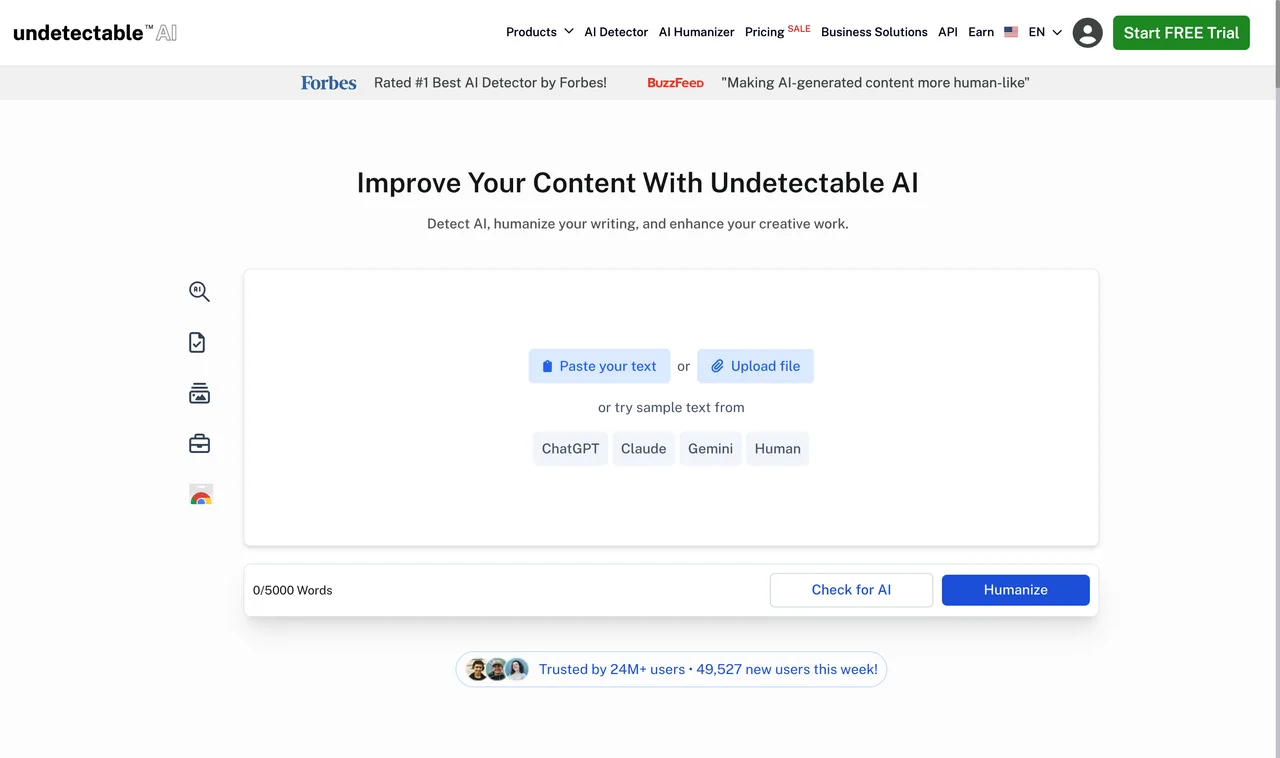
We submitted the same 93-word paragraph used throughout this review series. The interface was set to Basic, University readability, General Writing and Balanced. The visible main input showed a 5,000-word cap, comfortably above our sample.
The complete Basic result appeared after a wait. We retained that output rather than repeatedly generating alternatives. It was roughly 150 words, compared with 93 in the original, so the tool expanded the report substantially.
The entire sample worked without an account in Basic mode. We did not exhaust a guest quota, so the 5,000-word input cap should not be read as a recurring free word allowance. It tells us how much the input box accepts, not how often a guest may run it.
The distinction between Basic and the paid or registration-gated options should stay visible in a comparison. A reader considering an upgrade should not assume that our free output represents the strongest model. Equally, an advertised stronger model is not evidence that it would fix the specific omissions described here.
The schedule survived, but one number disappeared
The source describes a library testing a four-day schedule for six weeks while keeping 40 weekly opening hours. The rewrite retained the four-day schedule, six-week duration, Wednesday closure and later Monday and Thursday opening.
It also said the total hours stayed the same. That preserves the relationship between fewer opening days and unchanged access time. However, the actual number 40 was omitted. A reader of the rewrite alone could understand the arrangement but could not recover the weekly total.
This is an omission rather than an invented replacement figure. The output did not claim that hours were reduced or that the library was open for a different total. That makes the problem less severe than a wrong number, while still mattering in a factual report.
The repair is straightforward: put the 40-hour total back into the opening explanation. A review that focused only on whether the text sounded natural could miss this loss because the revised sentence reads smoothly without it.
Attendance and inconvenience remained recognizable
The output kept the weekly attendance figures of 1,200 and 1,320 and described the increase in the correct direction. It did not introduce a different percentage or attribute the change to an unrelated intervention.
The consequence for Wednesday visitors also remained. The rewrite says people who used to go on Wednesdays had to find a new day. That is a reasonable restatement of having to change their plans in response to the closure.
The reader can still follow the attendance increase alongside the inconvenience. That balance is useful: the rewrite has not removed the Wednesday visitors simply because total attendance went up. We would keep both facts in a shorter edit.
The added commentary is less useful. "The results were interesting" precedes the attendance figures, and "Of course" introduces the Wednesday inconvenience. Those phrases give the narrator a reaction to events that the source reports without comment.
The productivity caveat was handled well
The original says staff reported fewer interruptions but productivity was not measured. The rewrite preserves both ideas: fewer interruptions were reported, and the amount of work completed was not actually measured.
That distinction is important. A reduction in interruptions may be welcome, but it is not itself a measured increase in output. The returned paragraph did not turn the staff observation into proof of improved productivity.
The wording is plain and easy to follow. It gives a general reader a useful explanation of what the missing measurement means, without adding a new statistic or claiming the trial was invalid.
After describing fewer interruptions, the output adds "which was nice". We would delete that aside. It supplies approval without saying who held that view, while the following statement about unmeasured productivity already gives the reader the relevant limit.
Conditional benefits stayed conditional
Longer evenings may help people who work during the day. The source presents that as a possibility, and the output keeps it as a possibility rather than a demonstrated benefit.
The intended group also remains correct. The draft refers to daytime workers, rather than shifting the explanation to weekend access or another unrelated constraint. This preserves the reason extended evening hours might matter.
The rewrite then retains the warning against generalizing the result to every library. A single local trial does not establish that all libraries should reduce their opening days. That boundary is useful and remains clear in the returned text.
Together, these sentences are among the better parts of the result. They are readable, faithful and appropriately cautious. Their success also shows why we evaluate the actual clauses rather than assuming that a longer or more casual rewrite must be less accurate throughout.
The follow-up plan was preserved
The closing section keeps the plan to ask residents for their views, compare costs and repeat the trial in winter. It also retains uncertainty about people's habits, although the rewrite drops the source's more specific word "travel". We would restore that detail along with the 40-hour figure.
The output does not assume that the new schedule saves money. It leaves the cost comparison open, which is consistent with a team still deciding whether to make the change permanent.
It also avoids specifying an unsupported direction for winter behavior. Residents might travel differently, but the source does not say they will travel less or stay home more often. The rewrite preserves that uncertainty.
The final decision is still pending those checks. That is worth preserving when cutting the longer prose: the team has observations to investigate, not a completed case for making the schedule permanent.
Is the extra length worth keeping?
The output reads like someone explaining the trial aloud. It breaks the information into accessible sentences and uses common words. For an informal audience, that can be easier to follow than a dense paragraph.
The 150-word result is 57 words longer than the source. Some of that space helps separate ideas; some is spent calling the findings interesting or nice. Removing those asides would shorten the report without losing a fact or qualification.
The selected University setting did not produce an especially academic voice in this sample. That is an observation about this run, not a rule about the control. We did not test every readability setting or measure how reliably the selector changes tone.
Our voice score reflects this tradeoff. The draft is understandable, but the casual additions feel applied rather than necessary. Natural writing can be restrained; it does not require a comment after each finding.
Reviewing changes in the interface
The workflow produced a complete result and exposed several controls before generation. We could inspect the returned text and compare it with the source. The full evidence is preserved on the separate tool profile.
We did not verify a word-level insertion-and-deletion display or a line-by-line rewrite diff in this workflow. Nor did we complete a selective sentence replacement. Those capabilities therefore do not receive verified feature tags in this review.
Mode selectors and detector indicators answer different questions from a change diff. A selector tells the tool how to attempt a rewrite. A detector label describes a scoring system. Neither identifies every factual detail removed from the original.
For this result, manual comparison was enough to find the missing 40-hour figure. On a longer document, that kind of omission would be harder to spot. A useful practical test is to check numbers, named days and caveats before spending time polishing the new voice.
Web pricing uses word allowances
The monthly price view showed $19 for 20,000 words per month, $31 for 35,000 and $42 for 50,000. A larger 80,000-word option was also displayed at $64. These are website plan observations, not a checkout receipt.
The annual view included 10,000 words per month for $60 billed yearly and 20,000 words per month for $114 yearly. Annual prices should be compared as annual commitments, even when the interface emphasizes a monthly equivalent.
The plan size matters alongside the price. A lower annual headline is not directly comparable with a monthly offer if it includes a different word allowance. We keep the billing term and quantity together in the parameter table to avoid that confusion.
We did not purchase a subscription, test paid limits or establish how every retry is counted. Someone rewriting long documents should verify both the chosen allowance and the rules for repeated attempts before relying on a headline price.
The humanization API is documented separately
Official Humanization API v2 documentation describes API-key authentication, a submission request and subsequent document retrieval. That is specific evidence of a humanization interface, rather than a generic API link elsewhere in a writing suite.
The developer pricing page showed a Starter subscription at $29 per month with 72,500 words and an overage rate of $0.40 per 1,000 words. Those terms belong to the API offering and should not be silently substituted for browser-plan allowances.
We verified the documentation, not a live integration. No API request was sent, no processing latency was measured and no failure-recovery behavior was tested. The API filter means a documented interface was found; it does not promise that a production client has been validated.
We did not verify an official MCP server or agent skill in the reviewed material. Those remain unknown rather than being inferred from the existence of a REST API. A developer who needs either should inspect the current official integration pages before committing to a workflow.
What the score represents
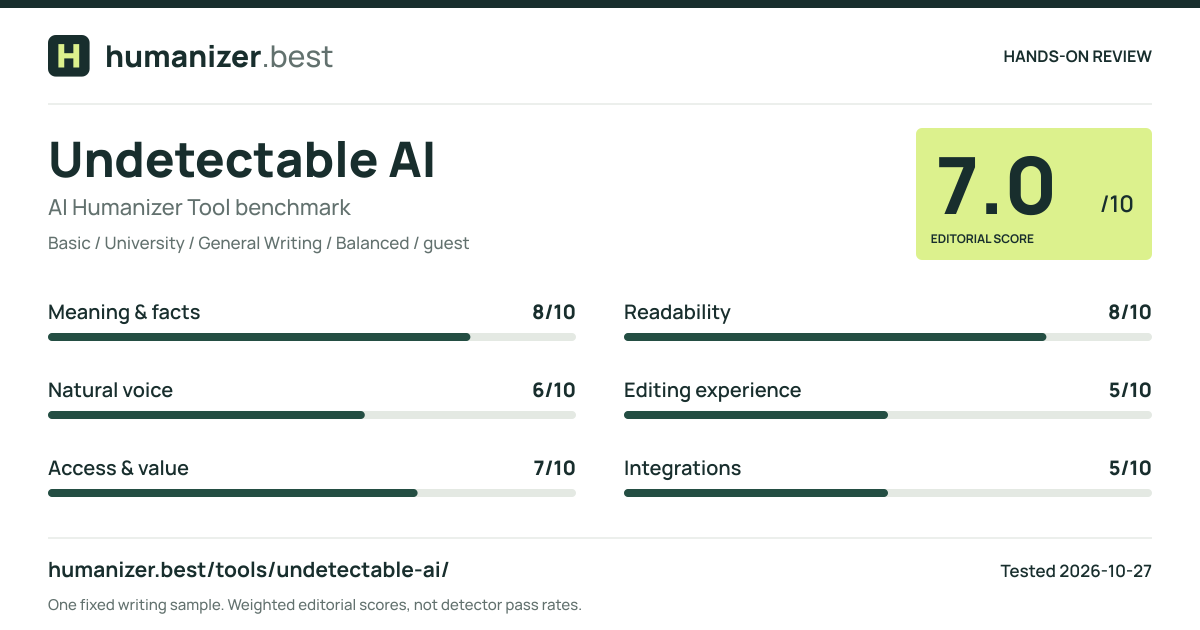
The weighted score gives the largest share to factual fidelity, followed by readability and voice. Editing support, free-value evidence and documented integrations make smaller contributions. The methodology publishes those weights and the fixed sample.
For Undetectable AI, most facts survived and the prose was readable. The missing weekly total lowered fidelity, while the extra reactions and expansion lowered the voice assessment. The successful free run and documented API contributed separately.
The score is not a detector bypass rate. We did not submit the output to independent detectors, and one short paragraph would not support a general claim about authorship classification anyway. The stronger gated mode also remains outside this result.
Basic produced a complete, mostly faithful draft. We would restore the 40-hour figure and the reference to travel habits, then remove the narrator's reactions. That is a modest repair list for this sample, though the longer output and missing detail leave room for a cleaner edit.
Sources and test scope
- Official guest Basic result and mode restrictions · checked 2026-10-27
- Official monthly and annual word allowances · checked 2026-10-27
- Official API pricing · checked 2026-10-27
- Official humanization endpoint documentation · checked 2026-10-27
One short English sample and the first captured output in the stated mode. Paid models, long documents, external detectors and live integrations were not tested. Pricing is a dated snapshot; documentation is not an end-to-end integration test.