humanizer
Prepostseo AI Humanizer review: generous input, awkward substitutions
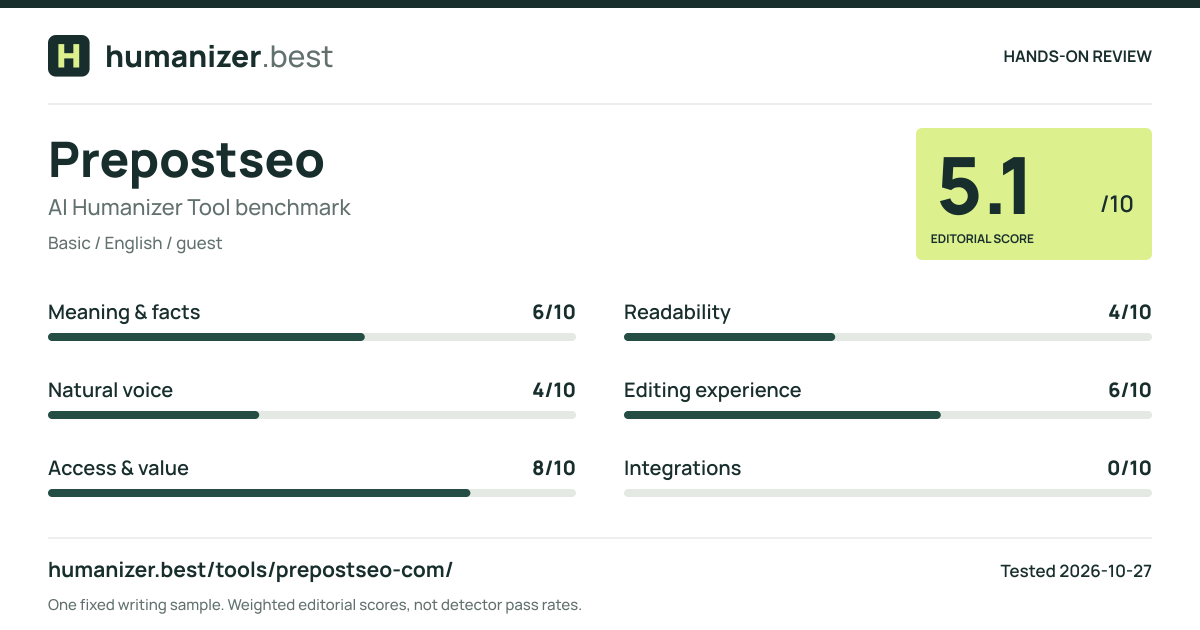
The free Basic mode preserved much of the report but introduced grammatical errors and changed productivity to production and costs to prices. A complete output still needs close editing.
The screenshots, complete input and output, feature table and scoring breakdown are on the separate tool profile.
View Prepostseo tool details and evidencePrepostseo's free AI Humanizer accepted the complete test paragraph without registration, but the first Basic result needed more grammatical repair than the original. It also changed two important terms: productivity became production, and costs became prices. Those substitutions look small on a word list, yet they are not interchangeable in this report.
We tested the English Basic workflow on October 27, 2026. The Prepostseo tool profile contains the actual input and result screenshots, the full text comparison and all six dimension scores. This article focuses on the returned prose and the practical limits of the free editing experience.
What the free test involved
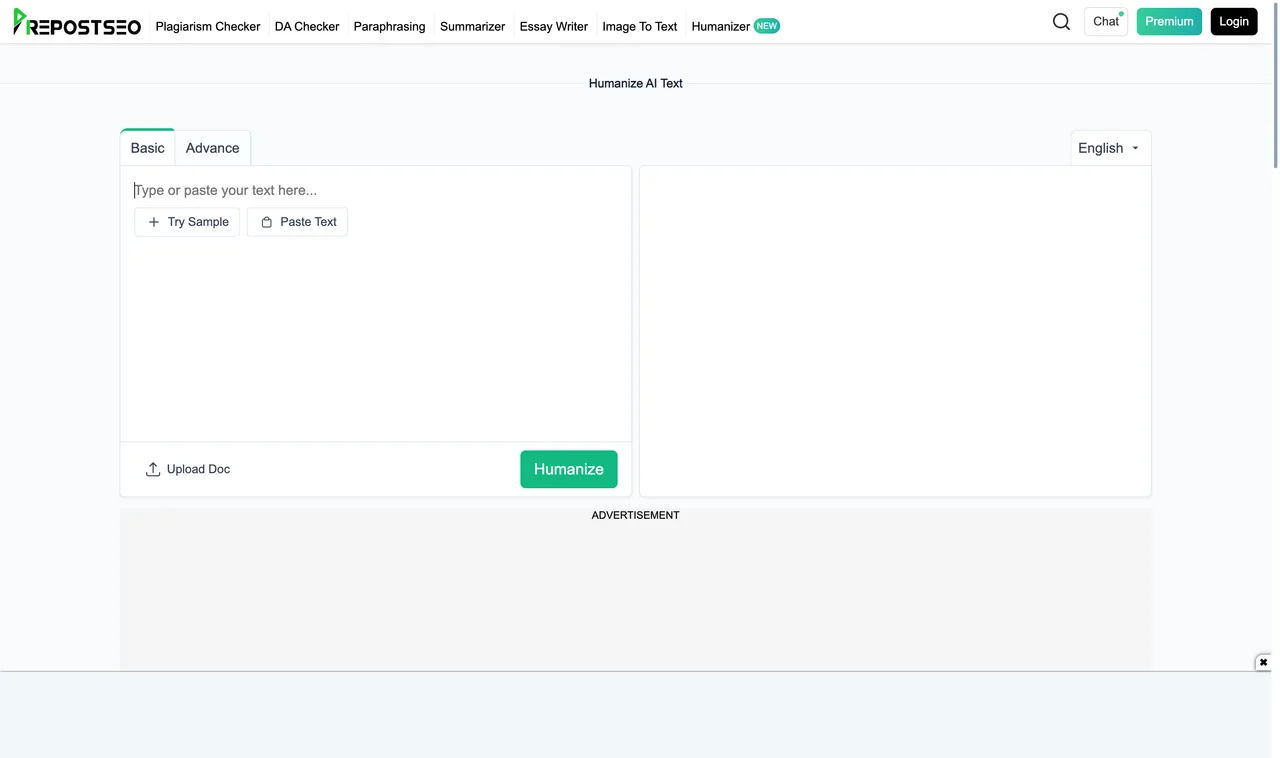
The editor displayed a 700-word input allowance. Our 93-word benchmark fit comfortably, and the tool returned a complete result without an account or payment. We did not shorten the sample, use a paid mode or regenerate until a better answer appeared.
The source is a fictional report about a library testing a four-day schedule while retaining the same 40 weekly opening hours. It includes attendance figures, a staff observation and several qualifications about what the trial does not establish. Those details give us a fixed basis for comparing different tools.
The default mode was Basic and the language was English. The output was roughly the same length as the input, rather than a long expansion. That is useful for a user who needs to preserve the shape of a short paragraph, but similar length alone does not establish similar meaning or improved readability.
We saved the first complete result, including its grammatical problems. The tool profile preserves that text; the repairs suggested in this article have not been applied to the evidence.
The large numbers survived
Prepostseo retained the four-day schedule, six-week duration and 40-hour weekly total. Wednesday remained closed, with longer Monday and Thursday evenings. Both attendance figures also survived, rising from 1,200 to 1,320 visits per week.
These are important points in its favor. The rewrite did not invent a different city, change the attendance total or replace the experiment with a generic statement about libraries. A reader would still recognize the basic event described in the source.
The inconvenience to Wednesday visitors remained too. This preserved a trade-off that some other outputs omitted. The result continued to acknowledge that an increase in total visits does not mean every existing visitor found the new schedule convenient.
However, retaining the numbers is only the first layer of a factual check. The meaning of an evaluation depends on what was measured, what remains uncertain and what the team plans to do next. That is where the terminology changes in this output become more significant.
Productivity is not simply production
The source says staff reported fewer interruptions, but productivity was not measured. Prepostseo changed the limitation into a statement about production not being assessed. In a library report, production is an unclear substitute for staff productivity.
Productivity concerns how effectively work is completed relative to resources or time. Production can refer to the amount of something produced. The original deliberately avoids claiming an efficiency improvement. Substituting a broader or different term makes that limitation less precise, even if the reader can guess the intended idea.
The sentence also says "staff members said less interruptions". It needs both a clearer reporting clause and the comparative "fewer" for countable interruptions. Restoring "staff reported fewer interruptions" would repair the grammar without changing the intended observation.
We would restore the original concept explicitly. That does not mean every technical term must remain untouched in every rewrite. It means a replacement must preserve the role the term plays in the claim. Here, the distinction between a staff observation and an unmeasured productivity outcome is part of the report's evidence boundary.
Comparing costs is different from comparing prices
The final sentence replaces a planned cost comparison with a comparison of prices. That may sound like a harmless synonym change, but it narrows or changes what the library team intends to evaluate. Operating costs can include staffing, utilities and other expenses; prices do not automatically capture that broader analysis.
The source does not specify which costs will be compared, so the rewrite should not silently choose a different concept. It also should not assume savings. Prepostseo did not invent a savings result, but its substitution still makes the planned evaluation less faithful.
This matters because the paragraph ends with a decision process. The team will gather resident feedback, examine costs and repeat the trial before making the change permanent. Altering one part of that process changes what evidence the reader expects the team to collect.
A practical repair is to use "costs" again. There is no new evidence here to support changing the object of the comparison. The team still needs to evaluate what the schedule costs to run before making it permanent.
The opening sentence became less grammatical
The first sentence says a library "experimented a four-day schedule". "Experimented with" would be grammatical, while the original's "tested" is shorter and direct. The rewrite omitted a necessary preposition while replacing a verb that already worked.
Later phrases also need attention. The result uses an unnatural comparative construction for interruptions and a less idiomatic expression for operating on fewer days. These issues are not hidden in a long document; they appear within a single short paragraph.
Some substitutions changed the register without improving it. Referring to library visitors as guests is possible, but it is less direct in this context. Longer nights is also less precise than longer evening opening hours. Each phrase can be interpreted, yet the reader has to supply more context than before.
We therefore score readability and natural voice separately from basic comprehensibility. The output is not unreadable. Its weakness is that a tool intended to polish the prose introduced several phrases that an editor would immediately revise. Being able to infer the intended meaning is a lower standard than producing clear, idiomatic writing.
The ending still had useful restraint
The output retained the warning against applying the schedule to every library. It also kept the resident survey and a winter repeat of the experiment. Seasonal travel patterns remained uncertain rather than being replaced by an invented prediction.
Those retained qualifications matter. The paragraph did not turn into a blanket recommendation that libraries should close more often, nor did it claim that productivity had been proven to improve. This is why the factual score is mixed rather than uniformly poor.
The final sentence's ordering was less tidy, however. The qualification about winter travel and the phrase about formalizing the change were placed together in a way that made the sentence harder to parse. A reader can recover the intended sequence, but the original presented it more cleanly.
Before publishing, we would restore the precise terminology and simplify the sentence structure. That would preserve the useful content the tool kept while removing the unnecessary ambiguity introduced during rewriting. It is a repairable draft, but the repair work is not trivial relative to the length of the source.
The editing workflow
The result was available in an editable area, which is useful for making those corrections. The page supplied output controls, and the complete text could be recovered for comparison. The full-text humanization action worked in the free Basic workflow.
We did not verify an inserted-and-deleted-word diff or a separate line-level comparison. The profile therefore does not give the tool a change-highlighting tag. A user who wants to inspect small substitutions needs to compare the source and result manually.
We also did not establish a selective sentence rewrite that could repair one part while preserving the rest. Full-paragraph generation and manual editing are different capabilities from targeted regeneration. The review keeps those distinctions visible rather than grouping them all under a broad claim of one-click editing.
For our short sample, the easiest workflow would be to read the two versions side by side, mark the changed factual terms and then correct the grammar. A Copy action or an editable box can support that work, but neither verifies that the text is accurate before it leaves the page.
Free access and pricing
The strongest pricing evidence is the completed free run. The visible input cap was 700 words, and no login was required for our sample. That earns the tool credit for access and makes it easy for a reader to conduct a similar short test.
We did not verify a humanizer-specific paid plan or a stable price per rewrite in this session. Prepostseo offers a wider set of tools, but a price or quota for another product should not be copied into this comparison as though it automatically applies to humanization.
A per-input limit also says nothing by itself about how many requests can be made over a month or day. The review does not convert the observed 700-word cap into an unlimited-use claim. It simply records the capacity that was visible during the successful run.
If the intended workload is frequent or involves long documents, the user would need to verify those additional limits before relying on the service. Our value score reflects the useful free access that actually worked, while the writing scores reflect the amount of repair the captured output needed.
API, MCP and agent skills
The reviewed public navigation included a plagiarism API link. That is not sufficient evidence of a humanizer API. A platform can expose one capability programmatically while keeping another available only through its website.
We did not verify an official humanizer endpoint, MCP server or downloadable product-specific agent skill. Those fields remain unconfirmed. This is not a claim that the broader platform has no developer offerings; it is a boundary around the particular rewriting product being reviewed.
A developer evaluating an integration would need an identifiable request contract, authentication method and billing rules for humanization itself. Without those, it would be premature to assume that a script or agent can reproduce the browser's Basic mode and its output behavior.
The writing result would also need an editorial check in any automated workflow. Both disputed terms sound plausible in isolation; the error becomes clear when the returned paragraph is compared with the source. A successful API response alone would not catch that difference.
How we would use this result
We would treat the output as an alternative draft to inspect, not as a finished replacement for the source. Its preserved numbers and qualifications are useful, but the grammatical errors and imprecise substitutions reduce the benefit of running this particular paragraph through the tool.
The first editing pass should restore the factual terms. The second should fix the opening sentence and the awkward comparative phrases. A final read should confirm that the winter trial remains a planned follow-up rather than a completed result. Those steps are specific to the evidence shown here, not a generic promise that every output can be repaired as easily.
The free run is easy to inspect, but this Basic output gave us more grammar and terminology work than the source required. We would keep the original as the reference and repair those changes before considering the draft usable. Paid modes, detector bypass and long documents were not tested.
Sources and test scope
- Official humanizer and tested Basic editor · checked 2026-10-27
One short English sample and the first captured output in the stated mode. Paid models, long documents, external detectors and live integrations were not tested. Pricing is a dated snapshot; documentation is not an end-to-end integration test.