humanizer
MyDetector AI Humanizer review: faithful facts in a longer casual draft
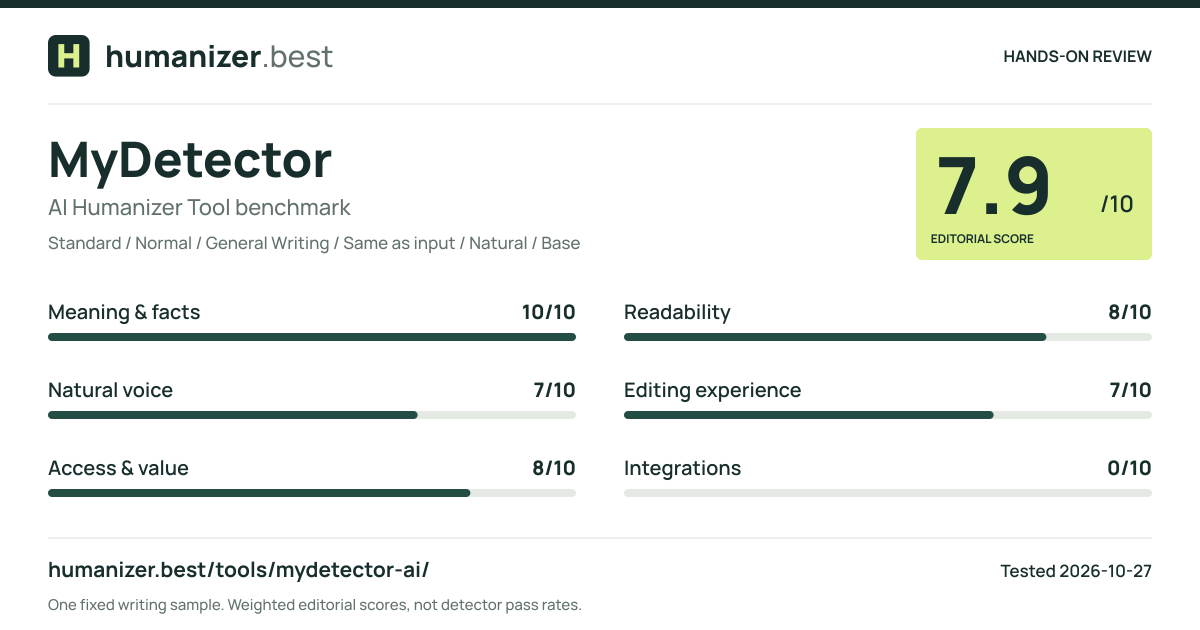
The free Base result preserved the library's facts and qualifications. It expanded the passage and added casual filler; sentence controls were visible, but no successful selective replacement was established.
The screenshots, complete input and output, feature table and scoring breakdown are on the separate tool profile.
View MyDetector tool details and evidenceMyDetector's free Base humanizer preserved the important information in our library paragraph. It kept the numbers, the schedule, the productivity limitation and the plan for a winter repeat. The main trade-off was length: a compact report became a longer, more conversational explanation with several extra sentences and a little filler.
That is a useful result for someone prioritizing factual preservation over brevity. It is less compelling if the original already fits a tight word limit. The tool did not invent a new finding in this run, but it did not make the paragraph more concise either.
We tested the first complete guest output on October 27, 2026. The MyDetector tool profile contains the actual screenshots, complete text comparison, pricing parameters and dimension scores. This article explains the writing result and the quota system behind the free and paid offers.
The settings and input
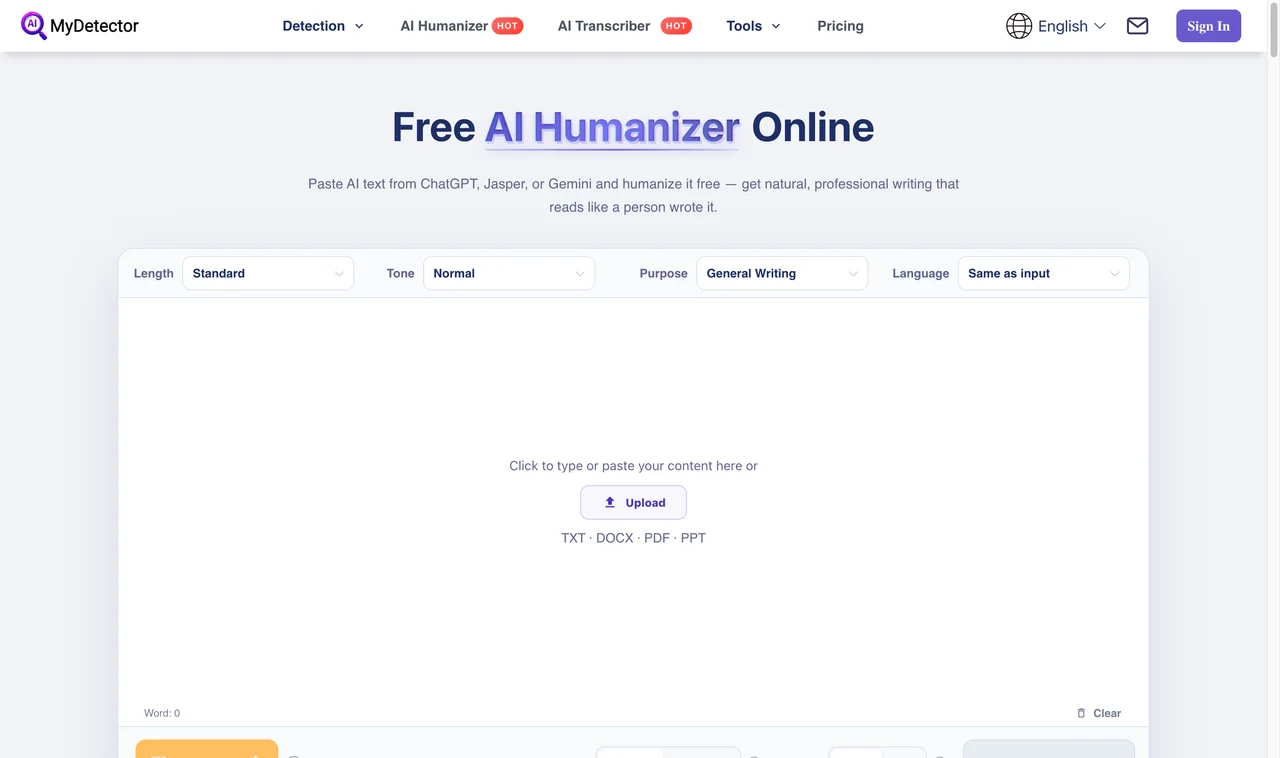
The interface showed Standard length, Normal tone, General Writing purpose and the same language as the input. Natural style and the Base model were selected. We kept those settings for the full benchmark rather than changing them after seeing the output.
Our source contains 93 words and 582 characters. MyDetector's counter displayed 95 words, but the actual text was unchanged. Products count punctuation and compound words differently, so the comparison uses the saved input rather than requiring every on-screen counter to agree.
The guest run completed without registration or payment. We saved the first output before interacting with any sentence controls. That matters because a later targeted edit could otherwise be mistaken for the original generated result.
The product offers other settings and a Pro model, but they were not part of this test. A review of the Base workflow cannot establish the quality of a different model or the effect of a different tone. Those would need their own recorded runs against the same passage.
The schedule was explained clearly
The opening retained the four-day trial and six-week duration. MyDetector then used a separate sentence to state that the library kept the same 40 weekly opening hours. Another sentence explained the Wednesday closure and later Monday and Thursday evenings.
This split made the operational setup easy to follow. The reader did not have to unpack several clauses at once, and the relationship between fewer days and unchanged total hours remained clear. The rewrite did not confuse a shorter opening week with a reduction in weekly service time.
The additional sentences also contributed to the expansion. Whether that is an improvement depends on the destination. A general-audience explanation may benefit from the slower pace. A short report or notice may prefer the source's more compact structure.
The new structure did not require inventing an earlier schedule or changing the duration. It begins with the four-day trial, gives the unchanged hours and then names the affected weekdays. Every part of that explanation can be traced to the source.
Both attendance figures survived
The output kept visits increasing from 1,200 to 1,320 per week. It did not round the numbers, reverse them or introduce a percentage that the source did not contain. The increase remained an observed change during the trial.
It also preserved the inconvenience to Wednesday visitors. People who normally used the library that day had to find another time. That maintains the report's balance: a higher total attendance figure can coexist with disruption for a particular group.
The sentence begins "Of course", which we would remove from a neutral report. The inconvenience needs to be stated; it does not need the suggestion that the reader should already consider it obvious. Removing the aside leaves the visitor fact intact.
Keeping these two ideas together is useful editorially. A rewrite should not turn a mixed operational experiment into a simple success story by deleting the cost to existing visitors. MyDetector's result remained reasonably faithful to the source's perspective.
The productivity caveat stayed intact
The source distinguishes staff reporting fewer interruptions from any measurement of productivity. MyDetector retained that distinction in plain language, describing the absence of tracking for how much work was completed.
That is an effective simplification for a general audience. It changes the terminology while keeping the evidential limit understandable. The result does not tell the reader that staff became more productive, only that fewer disruptions were reported.
A humanizer can easily overstate this kind of relationship. Fewer interruptions sound beneficial, and it is tempting to infer improved efficiency. The source explicitly withholds that conclusion. The captured Base output respected that boundary.
That sentence contributes to the 10/10 meaning-and-facts score. The draft explains what was observed and what was never measured, even as it uses more words to do so. We would retain the caveat in any shorter edit.
The conclusion and follow-up were preserved
MyDetector kept the possible benefit for people with daytime jobs. It also retained the warning that one test does not mean every library should reduce its opening days. The conclusion remained local and conditional rather than becoming general advice.
The ending kept all three planned actions: ask residents for feedback, compare costs and try the schedule again in winter. It preserved the possibility that travel habits might differ then. No specific seasonal behavior was invented.
This combination is important because the follow-up is part of the report's logic. The team has not finished evaluating the schedule. More evidence is planned before a permanent decision. The rewrite did not accidentally present the experiment as settled policy.
We found no material factual loss in the captured result. That is still a statement about one short paragraph, not a guarantee across all content. A longer document could create different challenges, and a different model or setting could behave differently. The evidence supports a strong score for this run within that scope.
Clear sentence breaks, a longer paragraph
The output was grammatical and easy to read. Shorter conceptual units made the report accessible, and the language avoided the forced synonyms that weakened some competing outputs. There was no assistant preamble to remove before reaching the actual content.
The expansion was substantial: the saved output has 131 words by our whitespace count, compared with 93 in the source. MyDetector displayed 133 under its own counting method. The extra length mostly spreads the same information across more sentences and conversational phrases.
That can help a reader who prefers a slower explanation. It can also make a concise update feel padded. We would trim the casual aside and consider recombining a few sentences if the destination is a brief report, newsletter item or tightly edited article.
The Natural setting should therefore be read as a style choice, not a universal improvement. Natural writing can be concise or expansive depending on the audience. MyDetector produced a clear casual version here, but the user still needs to decide whether that cadence fits the intended use.
What happened when we clicked a sentence
The result appeared beside the source, with Copy and Download controls. Individual sentences were clickable. We preserved the first output, then clicked the first sentence to inspect that behavior.
The interaction did not establish a successful replacement in the captured session. We therefore do not claim that selective sentence rewriting was completed end to end. A visible control or a processing state is not the same as a verified edited sentence.
We also did not verify a word-level insertion-and-deletion diff or a separate line comparison. Sentence clickability is a different feature from highlighting what changed. The profile keeps those fields distinct rather than assigning every editing-related tag to the same interface.
The side-by-side layout was still useful. It let us compare the facts and identify the increased length without leaving the page. For this short sample, that was enough to conduct a clear review, even without a dedicated word diff.
The free offer is a trial, not an unlimited allowance
The official pricing page describes one free trial for guests. Registration raises access to a Free plan with 20 quotas per month. Our completed run was the guest trial; we did not create an account to test the registered allowance.
This distinction matters for someone planning repeated use. A successful anonymous paragraph does not establish that the same user can continue indefinitely without an account. The directory's Free tag indicates that the shared benchmark completed without payment, while the price table explains the limits.
The page uses quotas rather than a simple number of rewrites. For the humanizer, it lists 1,000 characters per quota for the Basic model and 200 characters per quota for the Pro model. Different model choices can therefore consume the same account allowance at different rates.
We did not infer how fractional quotas are rounded or whether every request has a minimum charge. Those details were not established in the free test. A cost estimate for a larger workload should use the active model's documented conversion and confirm any rounding rule before treating it as exact.
Paid plans and their billing unit
The official monthly prices were $6.99 for Basic with 1,100 quotas, $14.99 for Pro with 3,000 quotas and $29.99 for Premium with an advertised unlimited quota allowance. We did not purchase any of those plans.
The plan names and model names should not be confused. A Pro subscription is an account tier; the Pro humanizer model has its own character-per-quota rate. The pricing table lists model consumption separately from the number of quotas included in a plan.
This is why comparing the lowest monthly price with a word-based product can be misleading. A quota may represent different amounts of text depending on the model and tool. The same account also covers other capabilities with different conversion rates, so a quota is not synonymous with one humanizer request.
For the tested Base workflow, the free result provides a useful quality sample. It does not establish that a paid model is better or that an unlimited plan will suit every workload. The value score reflects accessible testing and relatively clear published units, while leaving paid performance untested.
API, MCP and agent-skill status
We did not verify an official humanizer API, MCP server or product-specific downloadable agent skill in the reviewed public material. The directory therefore leaves those integration tags absent.
That is not a statement that the company has no possible developer offering. It means the evidence gathered for this review did not establish an identifiable humanizer interface with usable access documentation. A web editor and a collection of AI tools do not automatically imply programmatic support.
For an agent workflow, the unanswered question is how to call this Base humanizer with the same settings and how those requests would consume quotas. We did not find enough documentation to establish that path, and no integration was executed.
A person using the web editor can still judge the complete output on the profile. A developer needs further access evidence before relying on the product as part of a repeatable publishing process.
Our recommendation
MyDetector's Base humanizer is a useful free trial for someone who wants a readable, fact-preserving rewrite of a short paragraph. In our sample, it kept the evidence and qualifications intact, including the details most likely to be lost or overstated.
The main editorial decision is whether the extra length helps. We would trim the filler and tighten a few sentences for a concise report, while keeping the factual structure. The result needs less repair than many other outputs in the same comparison.
The one guest trial is enough to inspect this writing style before considering a plan. It is not evidence that the paid model is better or that a longer document will stay as faithful. Choose a plan only after checking how its quotas apply to the model and workload you intend to use.
Sources and test scope
- Official editor and first Base result · checked 2026-10-27
- Official plans and per-model quota conversion · checked 2026-10-27
One short English sample and the first captured output in the stated mode. Paid models, long documents, external detectors and live integrations were not tested. Pricing is a dated snapshot; documentation is not an end-to-end integration test.