humanizer
HumanizerTool.io review: a useful rewrite with stronger certainty
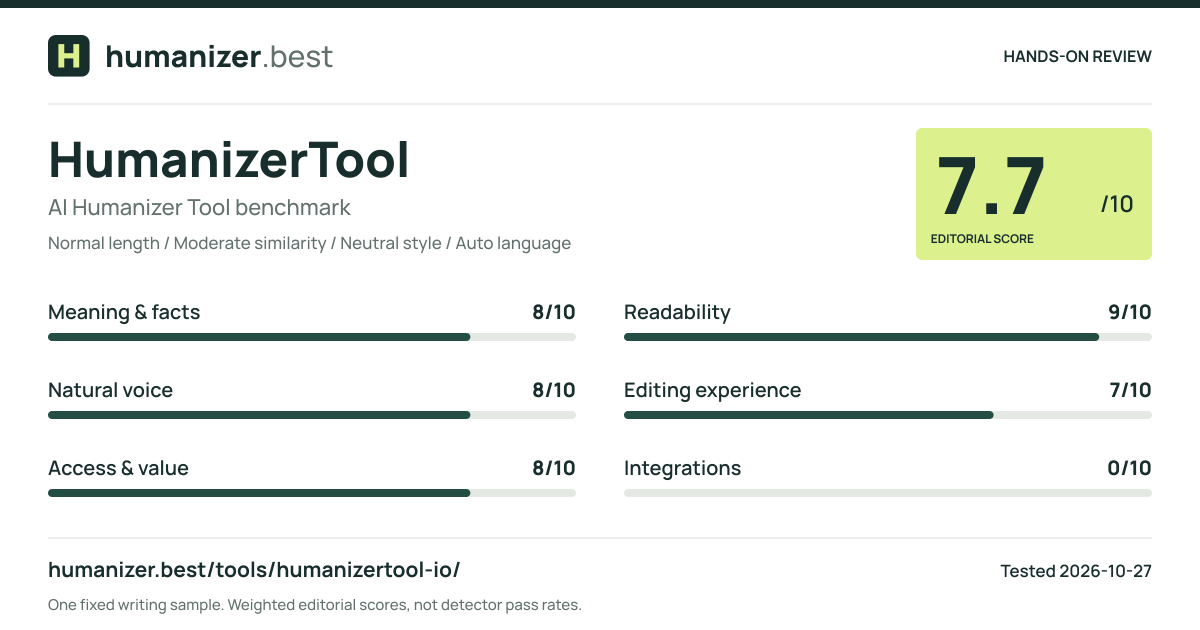
A readable guest rewrite preserved the main facts and offered sentence-editing affordances. It also turned tentative benefits and seasonal differences into stronger statements.
The screenshots, complete input and output, feature table and scoring breakdown are on the separate tool profile.
View HumanizerTool tool details and evidenceHumanizerTool.io produced a readable free draft, preserved the library's numbers and showed the result beside the original. The main writing issue was subtle: a possible benefit became more probable, and a possible seasonal difference became a definite one. Sentence-editing controls were visible, though we did not complete a selective replacement.
Those changes do not ruin the paragraph, but they are worth correcting in a report built around limited evidence. A humanizer can make prose sound more assured without being entitled to make the underlying claim stronger. This result shows why we score factual restraint separately from readability.
The test took place on October 27, 2026, using the first complete guest output. The HumanizerTool profile holds the actual screenshots, full text comparison, feature table and scoring. This article explains the practical strengths and the small but meaningful edits we would make before using the draft.
A generous input box for this sample
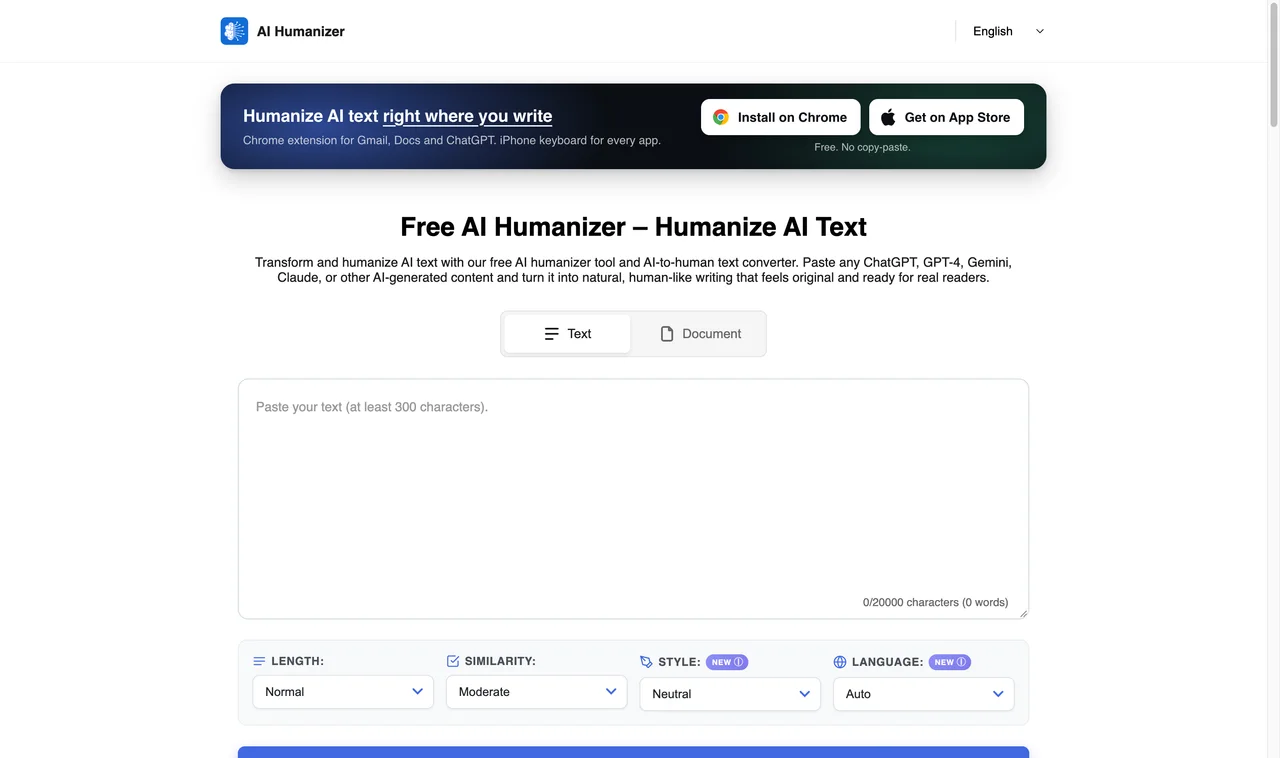
The free editor requested at least 300 characters and displayed a 20,000-character cap. Our unchanged benchmark contains 582 characters and 93 words, so it fit without modification. We did not split the passage or remove a sentence to meet an allowance.
The selected options were Normal length, Moderate similarity, Neutral style and Auto language. The input and output remained English. No account or payment was required for the completed run, which is the basis for the directory's Free and No signup tags.
The result page presented the original and rewritten text together. It also showed the selected controls again, making the context of the rewrite visible. We saved the first output before trying to optimize the wording or compare additional generations.
A large character cap is useful, but it is not a test of long-document quality. We processed one short paragraph. The result does not establish that a much longer document would preserve every section, maintain the same voice or complete within a predictable time.
The opening became more compact
The source begins with two sentences explaining the six-week, four-day trial and the unchanged 40-hour total. HumanizerTool combined those ideas into a single opening sentence while retaining the Wednesday closure and extended Monday and Thursday evenings.
That was an effective structural change. The relationship between fewer days and the same weekly hours remained clear. The rewrite did not imply that the library reduced its total service time, nor did it invent a previous five- or six-day schedule.
The combined sentence was still readable. It carried several facts, but the clauses followed a sensible order: the trial, the unchanged total and the redistribution of hours. This is a useful form of editing because it changes the presentation without discarding the information.
Not every sentence needs to be restructured, and a larger difference from the original is not automatically better. In this case, the opening change was supported by the source and served the paragraph's flow. It contributed positively to the readability assessment.
Attendance and the visitor trade-off stayed visible
The output retained visits rising from 1,200 to 1,320 a week. It also kept the fact that people who normally came on Wednesdays had to adjust. Those details preserve both the observed increase and the inconvenience to an existing group of visitors.
There was no added causal claim that the new schedule proved responsible for the increase. The sentence reported the change without supplying an explanation the source did not establish. That restraint is important in a short account of an experiment with limited evidence.
The visitor qualification became more conversational, but its meaning stayed recognizable. This is a good example of a plain-language change that does not need to sound formal to remain accurate. Simpler wording can preserve a trade-off just as well as a more administrative expression.
For a newsletter or website update, that style could be useful. A formal report might prefer the original register, but the factual content would not need substantial reconstruction. The score distinguishes that audience preference from an actual meaning error.
The staff caveat remained clear
The source says staff reported fewer interruptions while productivity was not measured. HumanizerTool kept both elements. Its wording about nobody measuring productivity was direct and easy to understand.
The output adds "actually" to "nobody measured productivity". We would omit the emphasis in a neutral report, but it does not assert a productivity gain. The original's limit on the evidence remains clear.
The staff observation was framed as something they felt or reported, rather than a new quantified measurement. The distinction is still imperfectly compressed in casual language, but the reader is not told that the experiment established a productivity result.
We would keep this part close to the returned version, with any final adjustment guided by the intended publication's tone. The larger corrections are in the degree of certainty attached to the proposed benefit and the winter explanation.
May became probably
The original says longer evenings may help people who work during the day. HumanizerTool changes that possibility into a statement that the longer evenings probably help people who cannot visit during daytime hours. The group is still relevant, but the level of confidence has increased.
Probably is not the same as may. The former suggests a judgment about likelihood, while the latter leaves the possibility open. The source gives no additional evidence that would justify making that likelihood assessment.
The rewrite also broadens the group from people who work during the day to people who cannot get there during the day. Employment is one reason someone might be unavailable, but not the only one. Keeping the original group would avoid adding that broader interpretation.
The repair is small: restore a conditional formulation that matches the source. The output does not need a wholesale rewrite. It needs the same restraint that it already preserved in other parts of the paragraph.
Winter differences became definite
The final sentence retained the survey, cost comparison and another trial in winter. That is a strong result for completeness. The seasonal explanation, however, became a statement that people get around differently in winter, instead of a possibility that travel habits may differ.
The source does not establish a seasonal pattern. It gives uncertainty as a reason to collect more evidence. Changing that uncertainty into a fact weakens the logic of the caution, even though the conclusion may sound plausible in everyday conversation.
A humanizer should not use plausibility as permission to strengthen a claim. The fictional benchmark provides all the information needed for the task. Any additional certainty comes from the rewrite rather than from new evidence.
Again, the practical correction is modest. Preserve the winter repeat and restore the possibility of different travel habits. This is why the result earns a strong but not perfect fidelity score: the main information survived, with two identifiable certainty shifts to repair.
Readability and voice
The prose was clear and mostly idiomatic. It avoided an assistant preamble, did not add a long explanation of the task and did not introduce obvious punctuation errors. The result read as a complete report rather than a chat response about rewriting a report.
Some phrasing was more conversational than the Neutral label might suggest. The warning becomes "a long way from proving every library should cut a day". "Cut a day" is also narrower than the source's "open fewer days": the original does not specify a one-day reduction for other libraries. We would keep the original scope of that warning.
The output was slightly longer than the source, but not dramatically padded. The extra words mainly supported a more conversational cadence. We did not see the same extensive expansion or forced synonym swapping that weakened several other samples.
For this paragraph, the writing was useful after a small factual edit. That is a more defensible claim than saying the tool makes any text indistinguishable from human writing. We did not test authorship attribution or external detectors, and the review does not depend on those outcomes.
Sentence controls are not the same as verified replacements
The result page invited the user to click a sentence and fine-tune individual wording. That affordance was visible, along with Copy and Download controls. We recorded it as part of the editing experience.
We did not complete a selective replacement and verify that only the intended sentence changed. The profile therefore describes the control as observed rather than claiming a tested sentence-rewrite workflow. That distinction prevents a tooltip from being treated as proof of a successful action.
We also did not establish a word-by-word deletion-and-insertion diff. A side-by-side presentation helps manual comparison, but it is not automatically word highlighting. Likewise, a clickable sentence is not a line-level change indicator.
The layout was still useful for reviewing this output. Seeing the original next to the draft makes it easier to catch the two certainty changes. For a longer document, a dedicated diff might reduce review effort, but that benefit was not measured in this short test.
What free means here
The complete guest run required no payment or account, and the editor's character limit was visible. Those are the concrete access findings. We did not establish an unlimited number of daily or monthly runs, nor did we verify a paid plan for this specific tool.
The site promotes browser and mobile products, but we did not install them. The completed test covers the web editor, not how the tool behaves inside another app or on a phone.
Without a verified paid allowance, it would be misleading to calculate a cost per thousand words or compare an assumed subscription with another product's confirmed plan. The price table therefore records the free test and leaves the unverified billing details explicit.
For someone with an occasional short paragraph, that may be enough information to try the editor directly. For regular production use, the next questions are renewal limits, document capacity and the consistency of repeated outputs. Our single successful run does not answer those questions by implication.
API, MCP and agent skills
We did not verify an official humanizer API, MCP server or product-specific downloadable agent skill in the reviewed public material. The directory leaves those tags absent rather than assuming that a web tool can be called programmatically.
An extension or mobile keyboard is not the same thing as an API. It can make a tool more convenient for a person in another application without exposing a documented interface for an agent or developer. Each type of integration should be evaluated on its own terms.
For an automation use case, the minimum useful evidence would include a request contract, authentication method, limits and a clear description of the returned result. We did not obtain that evidence here. No integration was installed or executed during the test.
For manual editing, the useful evidence is already on the profile: a clear rewrite with source and result together. An automated workflow remains unverified, regardless of how readable that browser output is.
Our recommendation after the first run
HumanizerTool.io is a reasonable free option to try for a short, neutral-to-conversational rewrite. It handled the shared sample without registration, preserved the key facts and presented the source and result in a useful comparison layout.
Before using this particular output, we would soften the claim about who benefits from longer evenings and restore uncertainty about winter travel habits. Those are small edits with a clear factual purpose. The rest of the paragraph needs less repair than many alternatives in the same test.
The first guest result gives us a useful draft after those targeted corrections. We would keep its readable structure, restore the source's cautious wording and avoid treating the visible sentence controls as a proven replacement workflow. Detector bypass and long-document reliability were not tested.
Sources and test scope
- Official editor, first result and editing affordances · checked 2026-10-27
One short English sample and the first captured output in the stated mode. Paid models, long documents, external detectors and live integrations were not tested. Pricing is a dated snapshot; documentation is not an end-to-end integration test.