humanizer
HumanizerPRO.ai review: documented API, factual slips in the free draft
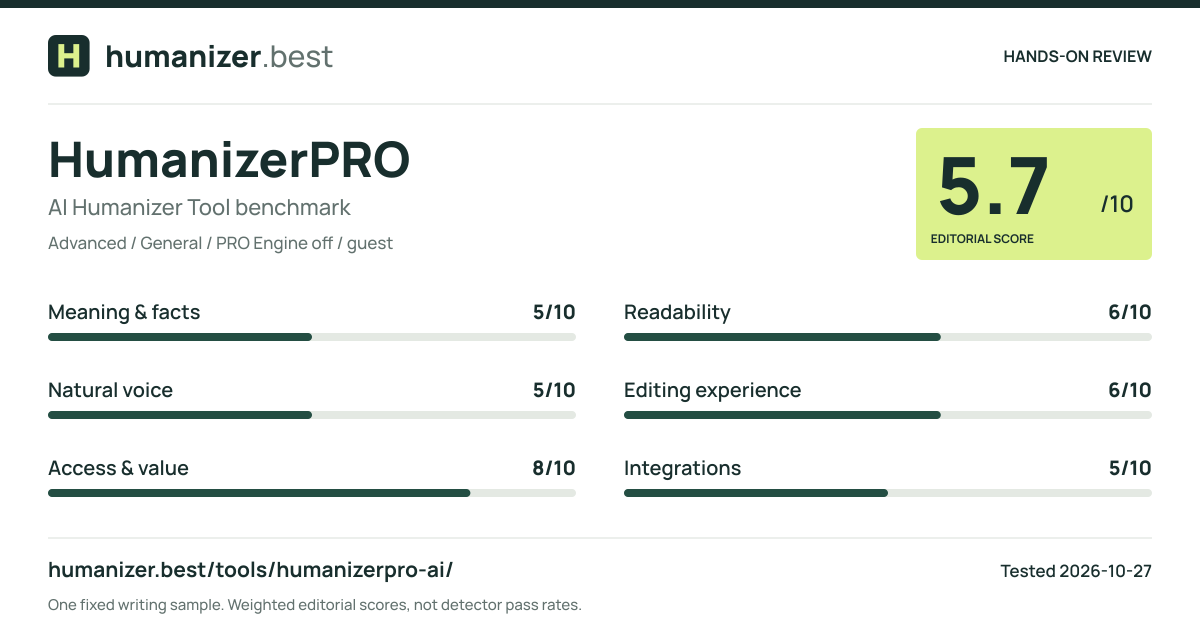
The Advanced guest result kept the main numbers but changed daytime workers to part-time workers and invented a winter behavior. Its humanizer REST API is documented separately.
The screenshots, complete input and output, feature table and scoring breakdown are on the separate tool profile.
View HumanizerPRO tool details and evidenceHumanizerPRO.ai's first Advanced rewrite kept the main numbers in our library test, but changed who might benefit from the schedule and invented a winter behavior. Daytime workers became part-time workers, and uncertain seasonal travel habits became a claim that people would be less likely to stay at home. Those are meaning changes, not stylistic improvements.
The product does have a separate strength for developers: official humanizer API documentation with ordinary and streaming endpoints, authentication examples and word-based pricing. We verified that documentation, but did not make a live API request. The browser writing result and the integration evidence are scored separately.
This review covers humanizerpro.ai, a different product from humanizer.pro. The HumanizerPRO tool profile contains the screenshots, full source/output comparison and dimension scores from October 27, 2026.
The free Advanced workflow
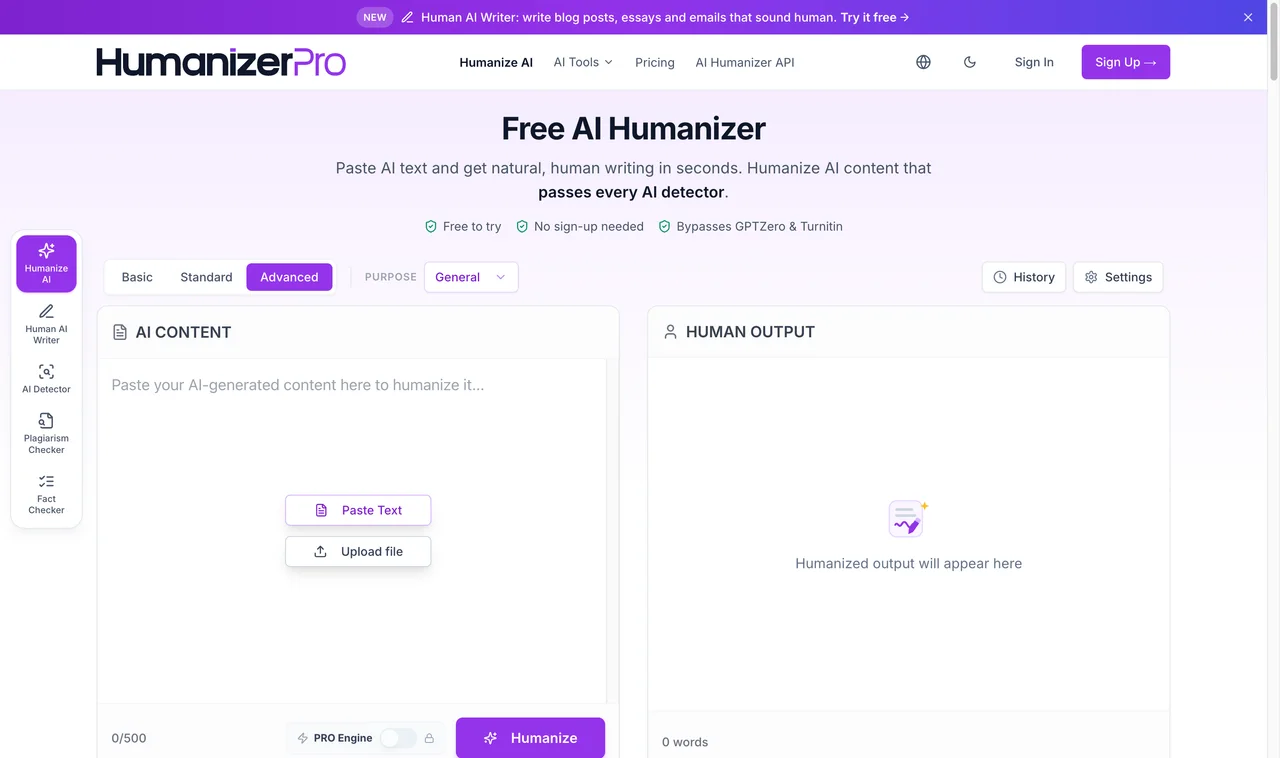
We opened the public editor and submitted the complete 93-word benchmark. Advanced was selected, the purpose was General, and the PRO Engine switch was off. The output completed without registration or payment.
Those labels need to be read carefully. The Advanced rewrite setting is not evidence that we used a paid Advanced subscription, and the disabled PRO Engine was not part of the test. Our result concerns the guest workflow with the visible settings recorded in the screenshot.
The public page advertises 500 free words per month without an account and 1,000 with a free account. The sample fit the guest allowance. We did not register to claim the larger quota or buy a plan to compare a different engine.
We retained the first complete captured output. It was displayed as a series of short paragraph-like lines, with a word count and additional proofreading or detection-related controls. We did not revise the draft before saving the evidence.
The basic schedule survived
The result kept the four-day trial and six-week duration. It retained the 40-hour weekly total, Wednesday closure and longer Monday and Thursday evenings. Both attendance figures also remained in the correct direction.
That is a useful factual foundation. The rewrite did not imply that total opening hours had been cut, and it did not invent a previous number of opening days. A reader could still understand the general design of the experiment.
The inconvenience to Wednesday visitors survived too. Their routines still needed to change, preserving the report's acknowledgement that the new schedule had a cost for some people even while total attendance increased.
The staff sentence retained an evidence limitation around uncollected efficiency data. Its wording was not identical to the source's productivity statement, but it did not claim that the trial had measured or proved an improvement. The main factual failures appeared later in the paragraph.
Daytime workers became part-time workers
The source suggests longer evenings may help people who work during the day. The output instead describes a benefit for part-time workers. Those groups are not equivalent.
A daytime worker may have a full-time or part-time job. A part-time worker may work during the day, in the evening or on another schedule. Replacing one category with the other changes the explanation of why extended evenings might be useful.
This is a subtle error because the new sentence sounds plausible. It remains about workers and library hours, so a quick topic-level scan may not catch the shift. A factual comparison needs to ask whether the same people and conditions are still being described.
We would restore the daytime-work condition. Part-time employment is a different category, not a broader version of the same group. The source's explanation depends on when people work, not how many hours their jobs require.
The winter claim was invented
The original plans a winter repeat because travel habits may differ. HumanizerPRO's output says people are less likely to stay at home in winter. That supplies both a direction and a level of certainty absent from the source.
The benchmark does not establish whether winter changes travel, let alone how. The seasonal uncertainty is the reason for collecting more evidence. Turning it into a specific behavioral claim makes the report sound more informed than the supplied material supports.
We cannot determine why the tool chose that wording, and the review does not speculate about its internal model. The visible issue is enough: a statement about possible differences became an assertion about what people are likely to do.
The correct repair is to restore uncertainty. The planned winter trial itself should remain, because it is a real part of the source. Removing the invented explanation without restoring the original qualification would leave the ending less informative than it needs to be.
Grammar and tone needed some cleanup
The output says "a increase", which needs "an". That small error is conspicuous in a short report. The sentence also changes weekly visits to weekly visitors; the figures survive, but the source does not establish that they count distinct people.
"Compare expenditure" is a more formal way to describe comparing costs, while "can be a boon" makes the possible benefit sound enthusiastic. We would keep the plainer source wording. Neither substitution helps explain the schedule, and the second sits beside the incorrect reference to part-time workers.
The result remained readable overall. We did not encounter random punctuation, an assistant preamble or a long off-topic explanation. That keeps the readability assessment above the weakest outputs in the cohort, even though the draft still needs correction.
The main editing priority is factual, not cosmetic. Fixing the article before increase would make the prose cleaner, but it would not repair the changed worker category or invented winter behavior. Those meaning changes carry more weight in the overall score.
What the editor offered
The browser showed the full source and result, along with a rerun action and proofreading or detection-related controls. The site also advertised per-sentence rewriting in its feature comparison.
We did not complete a selective sentence replacement in this test. Nor did we verify an inserted-and-deleted-word diff or a separate line-level change display. The profile therefore describes the observed and advertised controls separately.
A sentence replacement feature could be useful for repairing one local problem while keeping the rest of a draft. Its presence in a comparison table does not establish that the free workflow supplies it or that it preserves surrounding text. That needs an actual interaction test.
For the captured result, a manual edit would be straightforward: restore daytime workers, restore seasonal uncertainty and correct the small grammar issue. The user still needs the original to identify those repairs. A favorable detector indicator would not reveal them reliably.
Web plans use annual word allowances
The official pricing view showed Basic at $84 per year, displayed as $7 per month. It listed 180,000 words per year and a 600-word input limit. Pro showed $144 per year, 600,000 words per year and a 1,200-word input limit.
The Advanced plan showed $228 per year, two million words per year and a 3,000-word input limit. These are annual commitments in the captured view. We did not treat the displayed monthly equivalents as month-to-month prices or complete a checkout.
The annual word bank and the per-input cap answer different questions. A plan can contain enough total words for a workload while still requiring a long document to be split. Conversely, a generous input cap does not establish an unlimited annual allowance.
The free guest allowance was sufficient for this short test. We did not compare paid output quality, so the price table should not be read as evidence that a higher plan fixes the observed factual changes. It documents capacity and billing terms, not a measured quality improvement.
The API documentation is concrete
HumanizerPRO's official API page documents POST /api/v1/humanize and POST /api/v1/humanize/stream. It includes API-key authentication, request fields and example responses. Those details support the API tag, even though this review stops short of executing a request.
We verified the documentation rather than sending a paid request. The distinction matters: a documented contract supports an availability tag, but it does not establish latency, reliability, client compatibility or the quality of a live API output.
The page also lists separate API plans. The entry plan showed $37 per month for 100,000 words. Larger plans increase the monthly word allowance. These are separate from the annual web subscriptions described above, so they should not be combined into one apparent price.
The streaming option may be useful for an application that wants to display progress or text as it arrives. We did not test that behavior, error handling or how word consumption is charged after a failure. A developer should verify those details before building assumptions into a production workflow.
API does not automatically mean MCP or agent skills
We did not verify an official MCP server or downloadable product-specific agent skill for this product. The directory therefore gives it an API tag, not every integration tag.
A developer can sometimes build an MCP wrapper around a REST service, but that would be a separate implementation with its own maintenance and authentication choices. It should not be presented as an official product capability unless the vendor supplies and documents it.
The endpoint examples document REST requests. We did not find or install a product-specific agent-skill package, so a reader filtering for that separate capability should not infer it from the API documentation.
The integration score reflects a documented humanizer API, with live execution and other interfaces left unverified. This gives a developer useful information without allowing the documentation to hide weaknesses in the browser-generated prose.
How the scoring balances these findings
The writing dimensions account for the preserved schedule and numbers, the changed beneficiary group, the invented winter claim and the smaller grammar issues. The editing dimension accounts for a complete usable browser result while withholding credit for unverified diff and selective-rewrite behavior.
Access and value receive credit for the successful free guest run and the published distinction between web and API allowances. Integrations receive credit for an identifiable official contract. These are separate reasons, not a single impression of whether the product looks polished.
Someone who needs a developer interface may place more personal value on the API than our overall weighting does. Someone editing a one-off paragraph may care more about the factual slips. The dimension table lets readers make that trade-off without assuming the overall number is universal.
The result remains one test of one short English passage. It does not establish detector bypass, plagiarism clearance, multilingual quality or behavior on long documents. Those limits are part of the interpretation of the score, not exceptions hidden after the recommendation.
Our recommendation
HumanizerPRO offers accessible guest testing and concrete API documentation. The captured Advanced rewrite still needs a careful factual pass before use. We would correct the worker category, remove the invented seasonal behavior and repair the local grammar before publishing the paragraph.
For a developer, the API may justify further evaluation, but the browser score should not be treated as an API reliability test. For a writer, the free allowance provides a way to inspect the output without committing to a subscription.
For this result, the practical repairs are clear and fairly small, but they require the source: restore daytime workers, remove the invented winter behavior and correct the attendance sentence. The API documentation is a reason to investigate further, not a reason to skip those checks.
Sources and test scope
- Official guest editor · checked 2026-10-27
- Annual web plans · checked 2026-10-27
- Official REST and streaming API documentation · checked 2026-10-27
One short English sample and the first captured output in the stated mode. Paid models, long documents, external detectors and live integrations were not tested. Pricing is a dated snapshot; documentation is not an end-to-end integration test.