humanizer
Humanizer.Pro review: a fluent draft with an invented five-day baseline
The Advanced rewrite invented an earlier five-day schedule and blurred opening days with total opening time. The full free output was captured after an initial incomplete session.

The screenshots, complete input and output, feature table and scoring breakdown are on the separate tool profile.
View Humanizer.Pro tool details and evidenceHumanizer.Pro produced a complete Advanced rewrite of our library report, but several fluent changes weakened its accuracy. The ending invented an earlier five-day schedule. Elsewhere, a warning about opening on fewer days became a warning about reducing total opening time, even though the source explicitly kept weekly hours unchanged.
The paragraph also changed "productivity was not measured" into "there was no way to determine if staff productivity increased". That can be read as a comment on the missing evidence in this trial, but it is broader than the source's precise statement about what was not measured.
The Humanizer.Pro tool profile contains the actual screenshots, full original and output, feature table and dimension scores from October 27, 2026. This article explains why a readable surface did not make the captured result ready to publish. This is the product at humanizer.pro, not the similarly named humanizerpro.ai.
The free Advanced run
We submitted the unchanged 93-word sample used for every completed review. It describes a six-week library trial, contains attendance figures and identifies several questions that remain unresolved. Those constraints make it possible to inspect both numerical accuracy and the handling of uncertainty.
An initial session did not yield a captured complete output. A later attempt in the free guest Advanced editor did. We retained the first complete captured result rather than choosing the most attractive of several saved versions.
The saved output has 160 words by a whitespace count, compared with 93 in the source. It follows the same sequence of events and proposed checks. That familiar structure makes the added assumptions easy to miss on a quick read.
The result panel also contained vendor detector indicators. We did not independently validate those indicators or use them as the basis for our editorial score. The assessment comes from comparing the retained text with the source, clause by clause.
The schedule was initially described accurately
The opening kept a four-day schedule and the six-week duration. It also preserved 40 weekly opening hours, the Wednesday closure and longer Monday and Thursday evenings. Those are the main operational facts of the trial.
Keeping the 40-hour total matters because fewer opening days do not necessarily mean less access time. The library redistributed its hours. It did not simply remove a day's worth of service from the weekly total.
The output's opening makes that relationship clear enough. It is more formal than the source, but it does not initially replace the schedule with a different one. A reader can understand the basic arrangement from the first two sentences.
This accurate start makes the later inconsistency more significant. The paragraph establishes unchanged hours and then uses broader wording about reducing the amount of time libraries are open. A careful rewrite should maintain the distinction throughout, not only in the introduction.
The figures survived with an unnecessary qualification
The source reports weekly visits rising from 1,200 to 1,320. The output retained both values and their direction. It did not introduce a different baseline or reverse the change.
However, it described the new attendance figure as approximate. The original did not supply that qualification. In ordinary conversation the difference may seem small, but a rewrite should not change the precision of a reported number without a reason.
The inconvenience for Wednesday visitors also survived. The draft says some people had to adjust their schedules, which is consistent with the source's account of visitors changing their plans after the closure.
The attendance section is therefore mostly intact, with "approximately" the main wording change we would reverse. The larger problems appear in the later interpretation of the trial. Correct figures alone do not make that interpretation faithful.
The productivity limit became less precise
The original says staff reported fewer interruptions, but productivity was not measured. Humanizer.Pro retained the reduced interruptions, then stated that there was no way to determine whether productivity increased.
The source establishes a missing measurement. The rewrite may simply mean that the trial lacks evidence of a gain, but "no way to determine" can also sound like a stronger limitation on what could be established. We would avoid that ambiguity by restoring what the source actually says.
It also frames the unanswered question as whether productivity increased. The original leaves changes in either direction unmeasured. Returning to the neutral wording would preserve that scope without implying that the only outcome of interest was a gain.
The repair is small: "staff reported fewer interruptions, but productivity was not measured". That sentence gives the observation and its limit directly. It does not require either the tool or the reviewer to speculate about whether a measurement would have been possible.
Opening days became opening time
The source warns that the possible benefit of longer evenings does not prove every library should open on fewer days. Humanizer.Pro changed that into a statement about reducing the amount of time libraries are open.
Days and total time are different variables in this experiment. The weekly total remained 40 hours, while the distribution across days changed. A four-day schedule can preserve the same opening time by extending the remaining days.
The revised warning is therefore broader than the original and sits awkwardly beside the accurate opening. It can make the trial sound like evidence about cutting service hours, even though that was not the change being tested.
This is a consequential fidelity issue rather than a stylistic preference. A reader deciding how to interpret the trial needs to know whether the intervention changed days, hours or both. The rewrite should keep that distinction explicit when discussing any broader recommendation.
The five-day baseline was invented
The final sentence proposes comparing costs between operating five days and four days. The original never states how many days the library opened before the trial. It only describes the tested four-day schedule and the planned cost comparison.
A five-day baseline may sound reasonable, especially because one named day closed. But it is still an inference, and the source does not supply enough information to turn it into a fact. Other schedule changes could exist outside the short report.
The addition also changes the scope of the cost analysis. The original leaves the comparison neutral. The rewrite presents a specific five-versus-four-day comparison as the team's plan, making the account more detailed than the evidence supports.
We would remove the invented baseline and return to a straightforward statement that the team will compare costs. A useful humanizer should be able to rephrase the sentence without filling in missing facts from a familiar pattern.
What the ending kept correctly
Despite that invented comparison, the output retained the plan to survey residents and repeat the pilot in winter. It also kept the possibility that residents' travel patterns might differ in that season.
That seasonal uncertainty is handled more carefully than the productivity limitation. The draft does not claim that winter travel will certainly fall or that people will be less likely to leave home. It preserves the reason to gather additional evidence.
The permanent decision also remains conditional on the follow-up work. The library is still considering whether to keep the arrangement, rather than being described as having already adopted it permanently.
The final sentence needs a local correction, not wholesale removal. Keeping the survey and winter repeat while replacing the invented five-versus-four-day comparison with "compare costs" would preserve the useful information already there.
Readability is better than factual reliability here
The output is mostly grammatical. It follows a logical order and uses complete sentences. A reader can understand the broad story without repeatedly stopping to decode broken syntax.
The style is more formal and wordy than the original. Expressions about operating arrangements, cost differences and conducting surveys expand a short report without supplying new verified information. The long final sentence carries several separate future tasks.
There are also unnecessary qualifications, such as making the attendance figure approximate. Those choices can make the prose sound cautious while actually changing the source's level of precision. Formality and caution are not substitutes for fidelity.
For this sample, the draft would need factual repair before stylistic editing. Correct the invented baseline, distinguish opening days from opening time and restore the unmeasured-productivity caveat. Only then is it useful to decide which longer phrases are worth keeping.
Comparing the result in the editor
The tested workflow returned a complete source-and-output presentation with a vendor detector panel. That made it possible to preserve the result and inspect the rewritten paragraph against the original.
We did not verify a word-level insertion-and-deletion diff or a line-level change display. We also did not complete a selective sentence replacement. Those features remain unverified in the standardized parameter table.
A detector panel does not perform the same job as a change diff. It does not tell the reader that five days were added to the cost comparison or that the recommendation switched from days to total time. Those findings required reading the actual text.
Even a visual diff would be an aid rather than a final judgment. It could identify changed phrases, but a person would still need to decide whether each change preserves the evidence. This benchmark makes that distinction visible without relying on a detector score.
Free limits and the paid pricing ambiguity
The official pricing page listed 200 humanizer words per month and a 200-word limit per request for the free offering. Our 93-word sample fit within that input size and eventually produced a complete guest result.
We did not exhaust the monthly bank, test its reset or verify how repeated generations consume it. The successful sample establishes short-input access, not unlimited free use or reliable capacity for a long document.
The page displayed Unlimited pricing with $29.99 and $9.99 per-month figures across monthly and yearly billing modes. We did not verify the exact annual checkout total, so the profile preserves that uncertainty rather than presenting the lower headline as a confirmed month-to-month price.
No subscription was purchased. We also did not test the operational meaning of unlimited usage, any fair-use restrictions or the paid model's output. Those are separate purchasing questions that cannot be answered from one free guest rewrite.
API, MCP and agent skills
We did not verify an official humanizer API, MCP server or agent skill in the reviewed material. The directory therefore does not apply those capability tags to this product at present.
That is an evidence statement, not proof that no private or future integration could exist. A useful public integration claim needs a specific official interface or documented setup, rather than an assumption based on the site's name or similarity to another tool.
The similarly named HumanizerPRO at humanizerpro.ai has a separate profile and documented API. That evidence belongs to that product. It does not establish developer access for Humanizer.Pro.
For someone building an automated workflow, this review currently provides browser-output evidence only. It does not validate authentication, request handling, quotas, latency or error recovery for any programmatic interface.
How the rating was reached
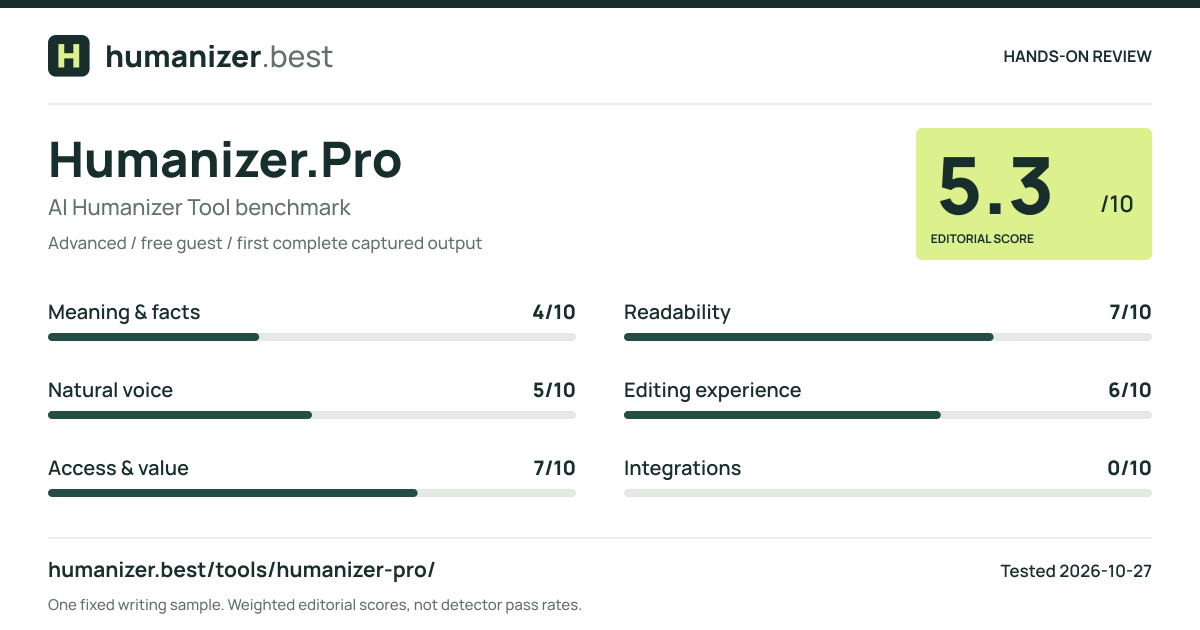
Our methodology gives factual fidelity the largest weight. Readability and voice come next, with smaller contributions from editing support, value and verified integrations. A fluent result can therefore receive a modest overall score when its meaning drifts.
Humanizer.Pro earned credit for preserving the main figures, opening schedule and several future checks. Its readability was also stronger than its fidelity. The invented five-day baseline and the shift from opening days to total time reduced the factual assessment substantially.
The completed guest sample earns 7/10 for access and value. Integrations receives zero because we did not verify an official interface. Those are separate from the 4/10 meaning-and-facts score, which reflects the invented baseline and shifts in the trial's interpretation.
We would treat this particular output as a draft requiring careful repair. It shows why a humanizer review needs the original paragraph alongside the result: the added assumptions sound ordinary enough to pass unnoticed. For this test, preserving the report's boundaries mattered more than making its sentences longer or more formal.
Sources and test scope
- Official Advanced editor and captured output · checked 2026-10-27
- Official free limits and paid billing modes · checked 2026-10-27
A completed retry followed an initial session with no captured output. First complete captured result retained. Vendor detector indicators were not independently tested. Paid use and integrations were not run.