humanizer
HumanizeAI.pro review: visible edits, missing qualifications
Green change highlighting helps inspection, but the free rewrite omitted staff observations, the productivity caveat and the winter retest. Those omissions matter more than the smooth presentation.
The screenshots, complete input and output, feature table and scoring breakdown are on the separate tool profile.
View Humanize AI tool details and evidenceHumanizeAI.pro highlighted changed wording in green, but the first free rewrite lost two parts of the report: the staff observation with its productivity caveat, and the winter follow-up. The highlighting helped us inspect new wording. Spotting the omissions still required reading the original.
We tested the free Balanced workflow on October 27, 2026 with the shared 93-word library paragraph. The Humanize AI tool profile contains the screenshots, complete input and output, pricing table and dimension scores.
A straightforward start
The browser editor accepted the complete passage without requiring registration. We left the rewrite level at Balanced and used the available free workflow. We did not pay for a higher plan, choose a different writing level or generate several alternatives to find a better result.
The site's word counter showed 94 words for our 93-word benchmark. That is a tokenizer difference, not a changed test. The underlying text was identical to the shared sample. Comparing the actual input is more reliable than assuming every product counts hyphenated terms and punctuation in the same way.
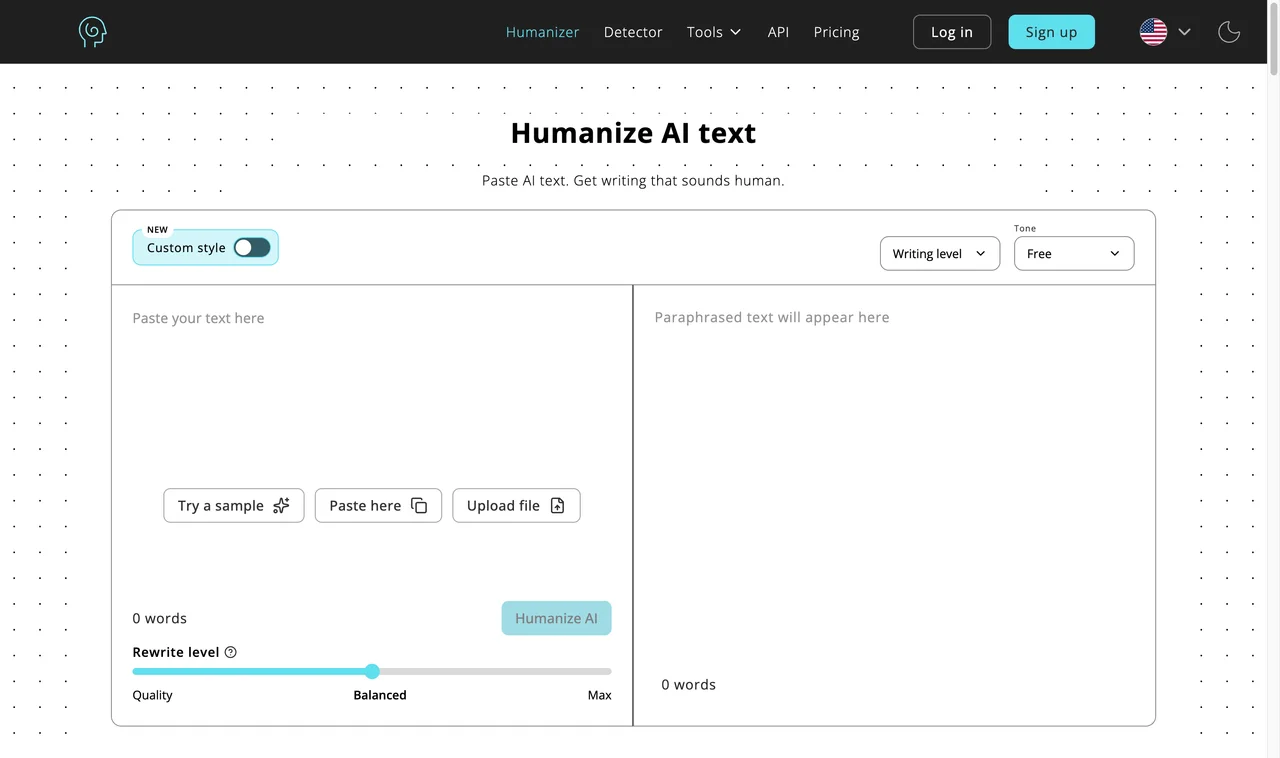
The first output appeared beside the source. It was longer than the original and contained green highlighting over much of the rewritten wording. An added-change toggle let us hide or show that treatment. Copy and an editable output area were also visible, giving the page a practical editing layout.
The comfortable layout should be judged separately from the text it produced. A good interface can make a weak rewrite easier to repair. It cannot restore a missing qualification unless the reader notices that it has gone. In this test, checking the unhighlighted source was essential.
What the rewrite preserved
The opening retained a local library, a four-day schedule and a six-week trial. The 40-hour weekly total remained, as did the Wednesday closure and the references to Monday and Thursday. The attendance figures also survived: 1,200 and 1,320 visits per week were still present in the output.
Wednesday visitors still had to adjust their plans. That was a useful detail to keep because it balances the apparent attendance benefit with a cost to existing users. A rewrite that removes that inconvenience would make the experiment seem more uniformly positive than the original describes.
The output also preserved a limited conclusion about longer evenings helping people who work during the day. It did not explicitly recommend reducing opening days for every library. Although the wording became more formal, the central caution against generalizing from one local trial remained.
Finally, the result retained a community survey and a cost comparison. These are two of the planned follow-up actions. A reader looking only for the largest numbers and the broad topic could therefore think that the rewrite had kept everything. The missing pieces become clear only with a sentence-by-sentence comparison.
The staff sentence disappeared
The original reports fewer staff interruptions and immediately adds that productivity was not measured. The returned text omitted that entire sentence. It therefore removed both an observation and the qualification that prevents an unsupported conclusion about efficiency.
This is not a harmless synonym change. The staff observation is one of the outcomes of the trial, alongside attendance. Deleting it narrows what the report tells the reader. Deleting the productivity caveat also removes an explicit limit on the evidence, even though the rewrite does not directly claim a productivity increase.
An editor preparing a summary might intentionally remove that information under a shorter word limit. That was not the task here. We asked the tool to humanize the same paragraph, and the output was not a concise version that needed to sacrifice detail. It grew longer while losing this part of the report.
The draft starts with "The experiment on the four-day week plan was carried out", a much longer way of introducing the trial. Later expansion does the same kind of work. The saved output totals 117 words, yet it contains less information than the 93-word source.
The winter follow-up disappeared too
The source says the team will repeat the trial in winter, when travel habits may differ. HumanizeAI.pro's result ended with the survey and cost comparison. It did not preserve the planned winter repeat or the reason for conducting it.
The omission changes the decision process. In the original, the team wants evidence from another season before making the schedule permanent. In the rewrite, the remaining actions could suggest that a survey and cost review are the whole plan. That is a materially thinner account of how the decision will be made.
The missing uncertainty also matters. Seasonal differences are a possibility, not an established pattern. Some other tools in our test invented a specific winter behavior. This output avoided that particular invention by dropping the topic entirely, but deletion is still a loss of fidelity.
A final edit should restore the winter trial and its conditional explanation. Simply checking that the last sentence sounds smooth would not catch the problem. The source needs to remain available throughout review, especially when the tool rearranges or expands the surrounding language.
A smaller ambiguity in the opening hours
The original describes extending Monday and Thursday evenings. The output says the library opened later on those days. That can be read as a later start time, rather than remaining open later into the evening. The surrounding reference to unchanged weekly hours helps, but the wording is less precise.
This is the kind of error that often escapes a quick factual check. The weekdays are correct, so a reader scanning for names and numbers may pass the sentence. The relationship between those details has nevertheless become ambiguous. Meaning depends on the action attached to a fact, not just the fact's presence.
The output also used cumbersome constructions for simple ideas. The sentence about the number of opening hours could be expressed more directly. Phrasing around operating fewer days needed grammatical cleanup. These are smaller issues than the omissions, but they add to the amount of manual work before publication.
We would repair the opening-hours description explicitly rather than rely on context to rescue it. The intended fact is that the library stayed open later in the evenings. A short, direct expression is both easier to read and harder to misinterpret.
What the green highlighting actually tells you
The change-highlighting feature is real in the captured free result. Added or altered text appears against a green background, and the toggle changes its visibility. This earns the product a word-highlighting tag in the directory.
It is not the same as a complete deletion-and-insertion diff. A green output can draw attention to new wording, but a sentence removed from the source may have no corresponding output segment to highlight. That is especially relevant here because the largest problems were omissions.
A reviewer should therefore use the highlighting as a guide, not as a substitute for reading the original. Compare each source sentence with its destination in the result. If a sentence has no destination, decide whether the information was deliberately summarized elsewhere or simply lost. In this case, the staff and winter material were not preserved elsewhere.
We did not verify a separate line or sentence diff. Selective rephrasing is advertised in paid plans, but our guest run did not establish that we could regenerate one sentence while keeping the rest. The green highlighting confirms a display feature, not that editing action.
Editing and copying the result
The output area was editable and a copy action was available. Those controls make manual repair practical. A user can restore a missing sentence, correct an ambiguous phrase and then take the revised paragraph into a document or publishing system.
These controls help with the repairs, but the repairs still take work. We would need to restore two missing passages and clarify the opening hours before polishing this draft. The short sample makes that manageable; a longer report would need its own test of how much information survives.
The interface also offered a detector action. We did not run an independent detector comparison, and the writing-quality score does not depend on detector labels. A passage can receive a favorable human score while omitting half of its supporting context. Our review is concerned with whether the resulting text remains useful and accurate to its source.
For this output, the sensible editing sequence is to restore missing information first, resolve the opening-hours ambiguity second, and only then smooth the prose. Polishing the language before checking completeness risks making an incomplete report more convincing.
Monthly and annual prices
We inspected both billing selections on the official upgrade page. Under monthly billing, Lite showed $9.99 per month with 10,000 humanizer words. Standard showed $19.99 with 25,000 humanizer words. Unlimited showed $59.99 per month and advertised no monthly humanizer word cap.
The annual view displayed monthly equivalents of $4.99, $9.99 and $29.99 respectively, billed annually. Those figures should not be compared with another product's monthly subscription as though the commitment were identical. We did not complete checkout, so the review records the displayed billing mode rather than claiming a charged total.
The plans also list separate paraphraser allowances. Lite and Standard show 5,000 and 12,500 paraphraser words respectively. Standard and Unlimited advertise unlimited re-humanizing and selective rephrasing. Those are paid-plan descriptions, not capabilities we verified through a purchase.
The free sample required neither payment nor an account. That establishes useful trial access, but not that a subscription would solve the omissions in this particular result. We did not compare the same paragraph across paid settings, so there is no measured quality uplift to attach to the price difference.
API and automation status
An API item appears in the product navigation. Its destination is an account section. We did not verify a public endpoint contract, authentication instructions or a successful humanizer API response from that link. The profile therefore records an advertised API entry rather than awarding a verified API tag.
No official MCP server or product-specific downloadable agent skill was established in the reviewed material. This is an evidence limit, not a claim that such features can never be offered. If usable documentation becomes available, the feature table can be updated independently of the browser writing score.
A developer should also distinguish automating access from automating editorial judgment. Even if the same rewrite were available through an API, the missing staff sentence and winter plan would still need detection. An integration makes a workflow easier to call; it does not establish that the output preserves every claim.
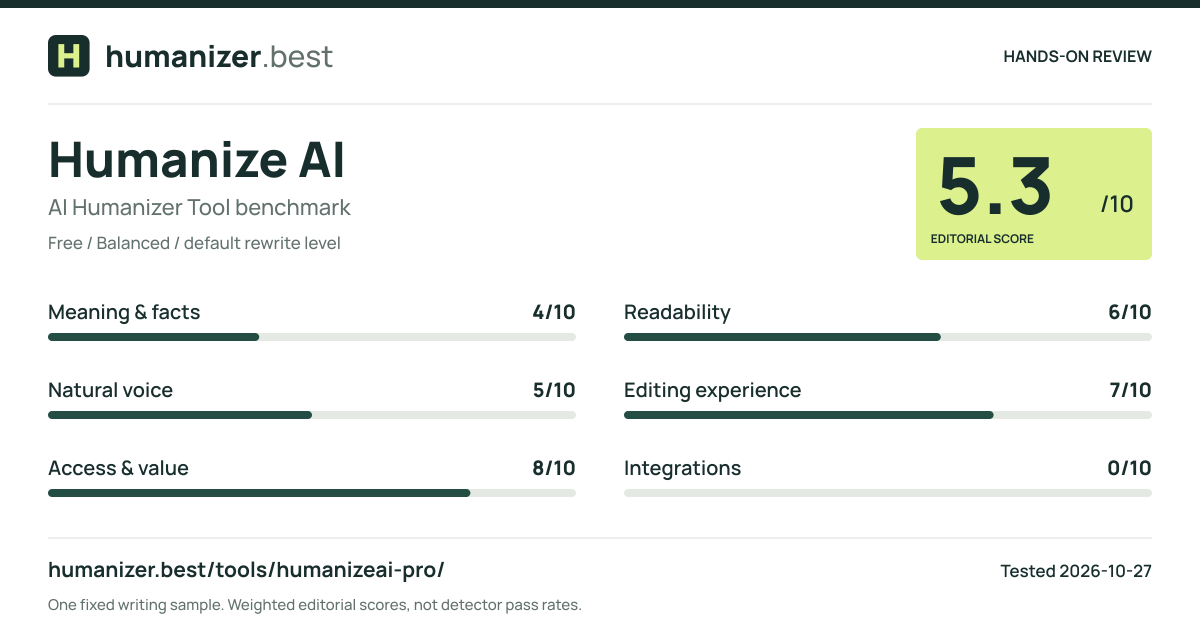
The score breakdown makes this visible: editing earns 7/10, meaning and facts 4/10, and integrations zero for unverified availability. The green display is worth credit, but it does not compensate for losing the staff and winter material.
Where this leaves the recommendation
HumanizeAI.pro's free editor is approachable, and its green highlighting is a useful review aid. The captured output nevertheless lost two substantial parts of a short report and made another detail ambiguous. We would not accept this particular draft without checking it against the complete original.
Before deciding whether this tool saves work, compare the source claims with their destinations in the rewrite. For our sample, two passages have no destination at all. Restoring them and clarifying the evening hours would come before any stylistic polishing of the draft.
Sources and test scope
- Official editor and highlighted output · checked 2026-10-27
- Monthly and annual pricing controls · checked 2026-10-27
- API navigation destination; access not verified · checked 2026-10-27
One short English sample and the first captured output in the stated mode. Paid models, long documents, external detectors and live integrations were not tested. Pricing is a dated snapshot; documentation is not an end-to-end integration test.