humanizer
HumanizeAI.io review: a free rewrite that changed the numbers
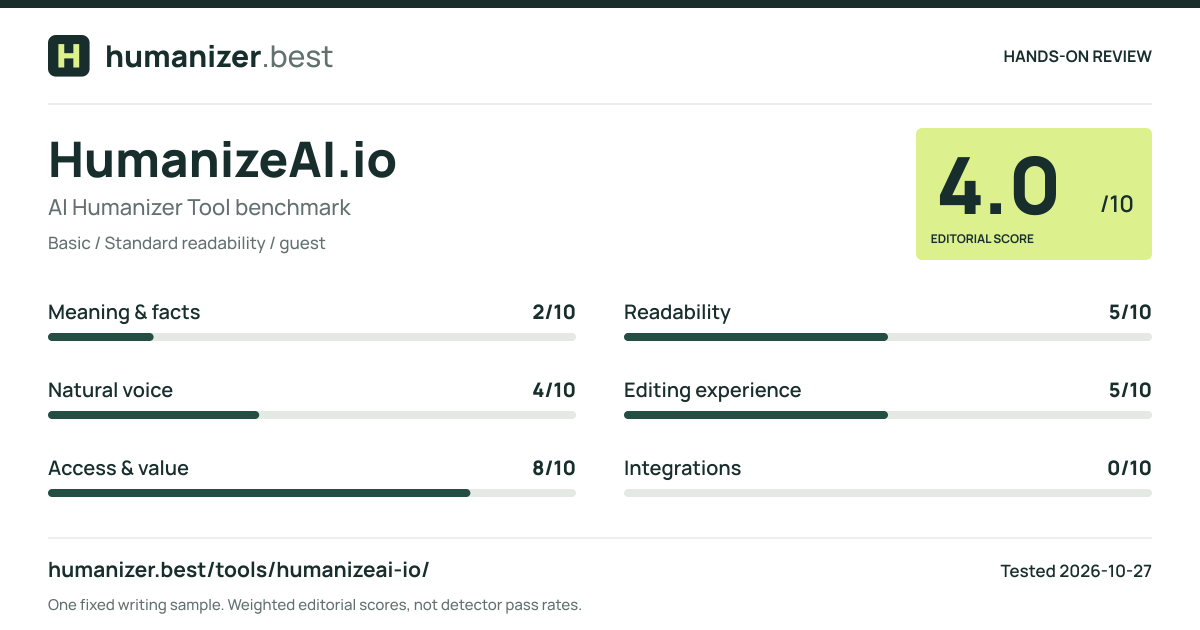
The Basic result invented a previous six-day week and changed 1,320 visits to 1,220. It also omitted the winter retest. Free access did not compensate for these factual errors.
The screenshots, complete input and output, feature table and scoring breakdown are on the separate tool profile.
View HumanizeAI.io tool details and evidenceHumanizeAI.io's free Basic rewrite changed the central attendance number in our test. The source says visits rose to 1,320 a week; the output says 1,220. It also invented a previous six-day opening schedule and removed the planned winter retest. Those are substantial factual problems in a short paragraph, regardless of how human the prose might appear to a detector.
The tool was easy to access. Our complete sample fit the free editor and returned a readable result without registration. That convenience earns credit in the access dimension, but it cannot offset incorrect data in the writing dimensions.
We tested Basic with Standard readability on October 27, 2026. The HumanizeAI.io tool profile contains the screenshots, complete input and output, feature table and scores for that run.
The free Basic run
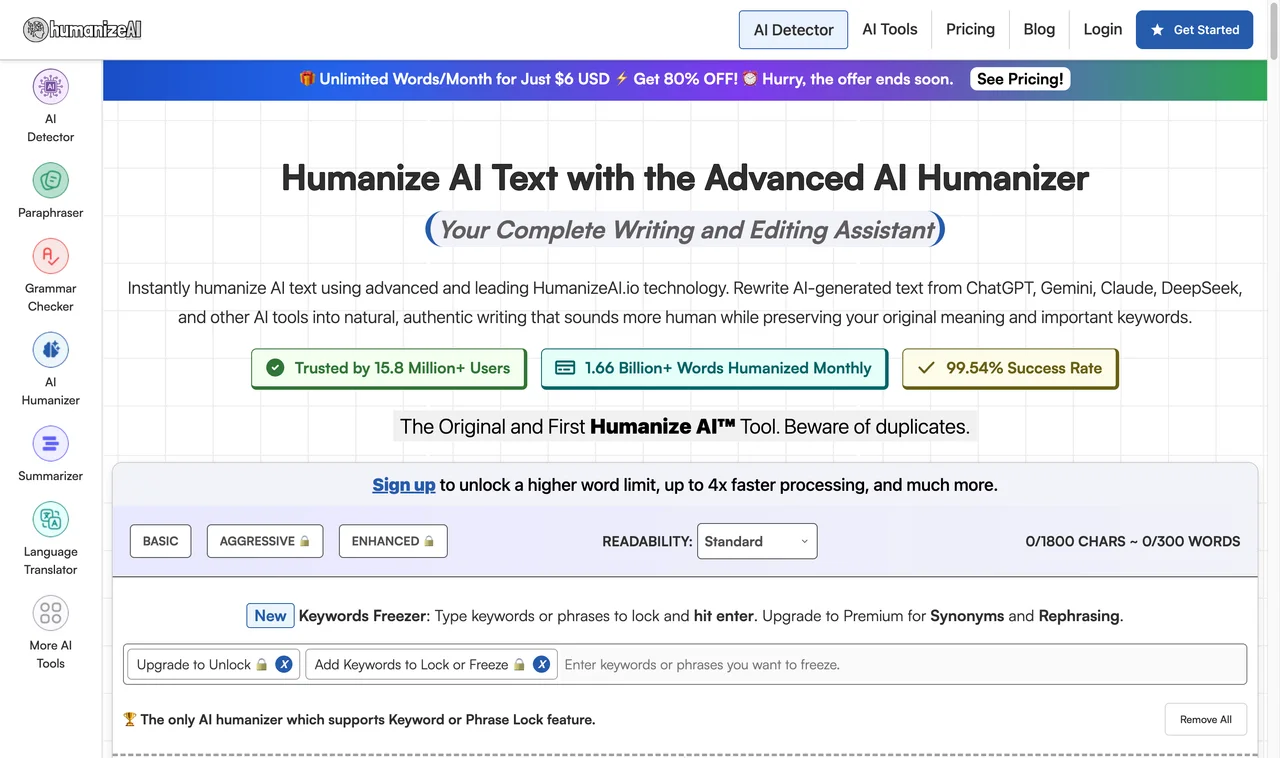
The editor displayed a limit of 1,800 characters, approximately 300 words. Our shared benchmark contains 582 characters and 93 words, so it fit without shortening. The product's own estimate showed a different word count, but the submitted text was identical to the fixed sample.
Basic was the available free mode, with Standard readability selected. Other modes were locked. The keyword-freezing field, synonym and rephrasing features, and Show Difference control were also presented as premium features. We did not upgrade to use them.
The first result appeared directly in the browser. Copy, Download and Use Again controls were visible. We saved the output before any further generation and did not manually correct its figures or wording in the evidence.
The interface described the output favorably while also warning that the Basic public model could still be flagged by detectors. We did not use either message as a writing-quality measure. The source comparison supplies much more concrete evidence about whether the paragraph remained accurate.
The original does not say the library opened six days
The benchmark says a library tested a four-day schedule for six weeks. It does not state how many days the library opened before that trial. HumanizeAI.io's result begins by supplying a six-day baseline that was never provided.
The source contains the number six only in the trial's duration. The output introduces a separate claim about six opening days. We cannot establish how that claim arose, but nothing in the input supports it.
The added baseline changes how a reader interprets the experiment. Moving from six days to four would be a particular reduction in opening days. The source deliberately does not specify that starting point, so the rewrite should not choose one.
The invented baseline changes the scale of the story. Readers are now told the library cut two opening days, although the source supplies only the new schedule. We would remove that background claim entirely before using the draft.
The attendance total changed
The source's two attendance figures are 1,200 and 1,320 weekly visits. The output retained the starting figure but changed the later figure to 1,220, writing it out in words. That makes the reported increase much smaller than the one in the original.
Writing numbers as words is not itself a problem. It becomes a problem when the transformation introduces a different value. A reader scanning a fluent paragraph may be less likely to catch the error when the number is embedded in a long written phrase rather than displayed as digits.
The error changes an increase of 120 weekly visits into an increase of 20. That is a different result, even though both versions describe attendance rising. We would restore 1,320 before making any judgment about the sentence's style.
This is the most decisive defect in the test. A humanizer intended for reports, articles or summaries must preserve the data it is given. A paragraph that sounds smooth while changing a measured result can be more misleading than one with obvious grammatical errors.
An observation became a causal claim
The original says visits rose during the trial. It does not establish that the schedule caused the increase. The rewrite states the change caused more people to come to the library, strengthening the explanation beyond the source.
A causal claim would require evidence that the benchmark does not provide. Other factors could be relevant in a real trial, but the source does not discuss them. The correct response is to preserve the observation, not invent certainty about its cause.
This error is independent of the wrong number. Even if the attendance total were corrected to 1,320, the causal wording would still need revision. Fixing a visible numerical mistake does not automatically restore every part of the original meaning.
The two problems together make the sentence particularly unreliable: it changes both the magnitude of the observation and the confidence of the explanation. We would rebuild that sentence from the original rather than attempt to polish the returned wording around it.
The visitor trade-off and winter plan were lost
The source notes that Wednesday visitors had to change their plans. HumanizeAI.io retained the closure but omitted that inconvenience. The resulting report therefore gives less attention to the people affected by the schedule change.
At the end, the original proposes a winter repeat because travel habits may differ. The output replaces that specific follow-up with a broader discussion of budgets, pros and cons and longer-term effects. A future winter test is no longer part of the plan.
Those changes make the ending less concrete. The original identifies what the team will do before making a permanent decision. The rewrite gives a more general description of deliberation, which sounds reasonable but does not preserve the same actions.
We would restore the visitor qualification and the winter retest explicitly. They are not minor decorative details. One balances the attendance outcome with a cost to existing users; the other explains why more evidence is needed before treating the experiment as settled policy.
What the output did keep
The four-day trial, six-week duration and 40-hour weekly total remained recognizable. Wednesday was still closed, and Monday and Thursday evenings were still extended. The staff sentence also retained a limitation around unmeasured efficiency, though the wording shifted from the source's productivity language.
The result kept a cautious statement that the experiment did not establish the same schedule for all libraries. It also retained the idea of asking patrons for feedback. These preserved elements explain why the output still reads like a version of the same report.
However, a recognizable topic is not enough for a strong fidelity score. The wrong attendance value, invented baseline, causal claim and missing follow-up affect several of the paragraph's main commitments. They require substantive correction rather than a few optional style choices.
The review therefore separates successful access from successful rewriting. The tool completed the request in the sense of returning text. It did not reliably preserve the information in that text during this Basic run.
Readability was not the main obstacle
Much of the output was understandable English. It used familiar language and complete sentences rather than fragments or random punctuation. A reader who did not have the source might find it plausible.
The saved output has 171 words, compared with 93 in the source. Repeated references to the library and the long written attendance figure account for some of that expansion. The ending adds a general discussion of budgets and long-term effects while dropping the specific winter test.
A grammar pass could leave "used to be open six days" and "one thousand, two hundred and twenty" untouched. Both phrases are readable. Their defects become clear only when they are checked against the source.
Our natural-voice assessment also considers whether the expansion serves a clear purpose. The extra explanation did not provide a distinctive authorial perspective or a more suitable structure. It largely made an already clear paragraph longer while changing some of its content.
Premium controls were visible but not tested
The Show Difference control was locked in the free workflow. So were features related to keyword freezing, synonyms and rephrasing. Their presence in the interface does not establish how well they work on a paid plan.
A difference view could help a user notice changed wording, but it would still require factual interpretation. Seeing that a number changed is useful; deciding whether the new number is correct depends on the source. No visual control can justify the invented six-day baseline without evidence.
Keyword freezing could potentially protect some terms, but we did not test it. We also would not assume that freezing a number protects the surrounding causal relationship or preserves a missing sentence. Those are separate aspects of meaning.
The profile therefore records the controls as premium-locked rather than awarding verified highlighting or selective-editing tags. A future paid test could examine them directly, but it should not be inferred from this free result.
Free access and the promotional price
The complete sample worked without an account or payment. That is a useful way to inspect the product before making a commitment. The visible character and word caps are recorded on the profile.
The editor advertised a $6 offer, but we did not verify its billing period or checkout total. That leaves us unable to say whether $6 is a monthly charge, an annual-plan equivalent or another promotion. The profile records the offer without assigning it a confirmed subscription period.
We did not buy a paid plan or compare Basic with the locked modes. The test therefore cannot establish whether a subscription would avoid the factual errors. A plan may provide more capacity or different models without a measured improvement on this particular paragraph.
For a price comparison, the honest result is free access demonstrated, paid billing unconfirmed. That is more useful than a precise-looking cost per rewrite calculated from an offer whose terms were not established.
API, MCP and agent skills
We did not verify an official humanizer API, MCP server or downloadable product-specific agent skill in the reviewed material. Those fields remain unconfirmed in the directory.
A large collection of writing tools does not automatically imply developer access to the specific Basic workflow. A usable integration would need documentation of the endpoint or tool, authentication, limits and returned data. No such interface was run during this test.
A developer considering this output would need a way to catch the changed attendance value and missing follow-up before publication. We have no documented humanizer interface to recommend here, and the browser result itself would require those checks.
Our score does not speculate about features that might exist behind a paid account. It records what was observed and verified, with the gaps left explicit for later updates.
Our recommendation for this result
We would not use the captured Basic output as a replacement for the source. It needs the correct attendance figure, removal of the invented prior schedule, softer causal language and restoration of the visitor and winter details. At that point, much of the editing consists of undoing the tool's changes.
The free editor is easy enough to try, and the sample completed successfully as a browser interaction. The writing result is the limitation. A user should compare every numerical and conditional claim before copying this kind of output into a report.
For this paragraph, we would keep the clearer original. The Basic rewrite added a starting schedule, changed the attendance result and removed concrete follow-up work. The locked controls may warrant a separate test, but their presence gives us no reason to trust this saved output. Detector bypass and paid-model quality were not tested.
Sources and test scope
- Official Basic editor, output and locked premium controls · checked 2026-10-27
One short English sample and the first captured output in the stated mode. Paid models, long documents, external detectors and live integrations were not tested. Pricing is a dated snapshot; documentation is not an end-to-end integration test.