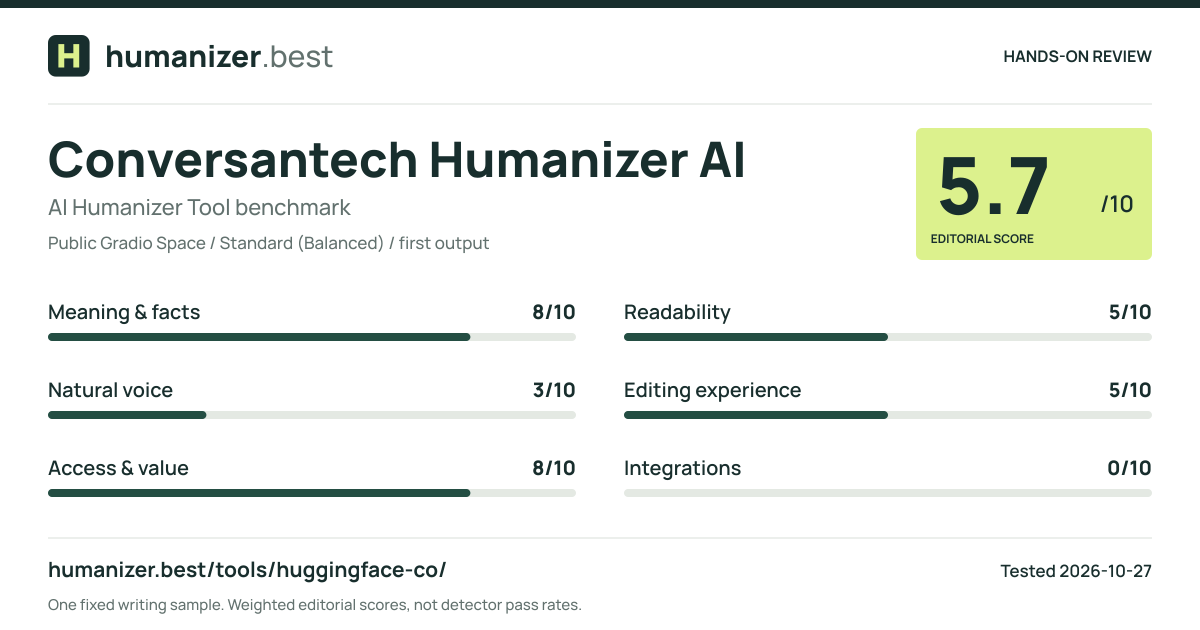
humanizer
Conversantech Humanizer AI review: a free Space with forced phrasing
The public Hugging Face Space produced a complete rewrite, but added Obviously, Look and the unusual word eventide. Its displayed detector results were not independently verified.
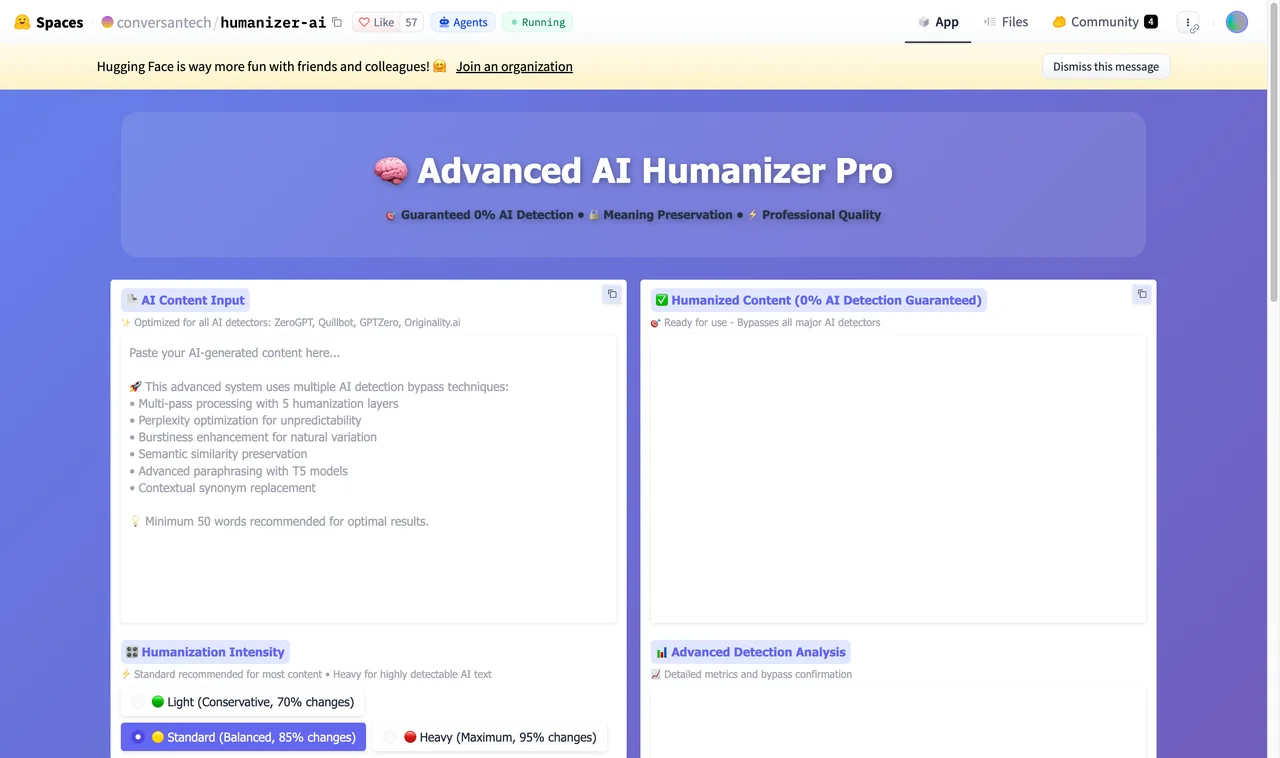
The screenshots, complete input and output, feature table and scoring breakdown are on the separate tool profile.
View Conversantech Humanizer AI tool details and evidenceThe Conversantech Humanizer AI Space returned a complete free rewrite, but its most noticeable changes made the paragraph sound less natural. It added discourse markers such as Obviously and Look, and replaced an ordinary reference to evenings with the unusual word eventide. The result kept most of the report's facts while weakening its voice.
The interface also displayed confident detector-related results. We did not independently run the output through those named services, so those labels are treated as claims shown by the app, not verified test outcomes. Our score comes from the actual text and the workflow we used.
We tested this specific Space by conversantech on October 27, 2026. The tool profile contains the screenshots, full source/output comparison and scoring. The review concerns the hosted app, not every humanizer or model available on Hugging Face.
Finding the actual application
The Google result led to a Hugging Face Space rather than a standalone commercial product page. Its embedded Gradio app exposed an input box, intensity choices, an output box and an analysis panel. We used the app's hosted page to complete the interaction after the embedded view was difficult to operate.
This distinction is useful for readers following the result. Hugging Face is the hosting platform, while conversantech identifies the creator of this particular Space. A platform account or subscription is not automatically a paid plan for the app being reviewed.
The public interface accepted our full 93-word sample without login or payment. Standard, described as the balanced option, was selected. We did not choose the Light or Heavy alternatives after seeing the result, nor did we compare multiple outputs and publish the best one.
The first complete rewrite is preserved exactly in the profile. It contains the inserted transitions, unusual synonym and contractions. None of those were cleaned up before the screenshot or text comparison was recorded.
Most of the source remained recognizable
The opening retained the local library, four-day schedule and six-week duration. The 40-hour weekly total remained, as did the Wednesday closure and Monday and Thursday references. Both attendance figures survived in the correct direction.
The output also preserved the inconvenience to Wednesday visitors. Staff interruptions and the lack of a productivity measurement remained in the report. The final warning against generalizing to every library was still present, followed by the survey, cost comparison and winter repeat.
Those retained details give the result a reasonably strong factual foundation. It did not invent a city, change the visit totals or delete the entire follow-up plan. A reader can still recover the original experiment without reconstructing the report from scratch.
The facts held up better than the style. The saved paragraph gives us specific wording to judge: "eventide", the added "Obviously" and "Look", and a change from "fewer" to "few" interruptions. These edits account for the weaker readability and voice scores.
The word eventide does not fit this report
The source uses ordinary language about extending Monday and Thursday evenings. The rewrite substitutes eventide in that context. The word is recognizable English, but it is a poor fit for a straightforward report about library opening hours.
It changes the register abruptly. Nothing else in the paragraph calls for a literary or archaic tone. The result sounds as though a synonym was selected for novelty rather than for the sentence's purpose and audience.
The grammar around the substitution also becomes awkward. A reader must interpret the intended evening-hours arrangement through a phrase that was clearer in the original. This is extra work created by the rewrite, not a complexity inherited from the source.
We would restore "Monday and Thursday evenings". There is no difficult idea to explain here and no literary voice to preserve; the ordinary wording tells the reader when the building stays open.
Added transitions did not add a perspective
The output inserted several conversational markers. One introduces the attendance increase as obvious, while another addresses the reader before the staff observation. These additions make the paragraph sound more performative without supplying new information.
Calling the increase obvious is particularly unnecessary. The source reports the numbers; it does not assume that the outcome should have been expected. A neutral account of an experiment can present a result directly without signaling that the reader ought to find it self-evident.
Addressing the reader before the staff sentence also changes the tone. It may suit an informal spoken explanation in some contexts, but there was no request for that voice. In this short report, it interrupts the flow between related observations.
Removing those two markers would leave the factual sentences intact. They add an attitude to the report, but the tool has no evidence that the person publishing it wants to sound impatient or surprised at the reader.
Fewer interruptions became few interruptions
The source says staff reported fewer interruptions. The result describes few interruptions. That small change weakens the comparison with the previous situation.
Fewer means a reduction relative to some baseline. Few describes an amount without necessarily establishing that it declined. The trial's reported outcome is the change, so the comparative form matters even though the general subject remains the same.
The productivity caveat survived through a contraction. The output still says productivity was not measured, which prevents a larger distortion into a claim of improved efficiency. We therefore treat the interruption change as a specific limitation rather than saying the whole staff sentence became false.
This is the sort of issue a word-level comparison would make easier to spot. A reader scanning for the presence of interruptions and productivity could miss the changed relationship. Our review checks the claim attached to the terms, not just whether familiar words appear.
The last sentence was relatively restrained
The plan to survey residents, compare costs and repeat the trial in winter remained. The output also kept uncertainty about travel habits rather than inventing a particular seasonal pattern. This was one of the cleaner parts of the rewrite.
The warning against applying the result to every library was preserved as well. The tool did not turn one local experiment into a general recommendation to reduce opening days. It retained the basic distinction between a limited observation and a broader policy claim.
This is why the meaning-and-facts score is 8/10 despite the weak voice score. The final plan is usable as written; most of the corrections belong earlier in the paragraph. We would not discard accurate sentences merely to make the verdict uniformly negative.
For a final edit, we would keep the retained factual structure and remove or repair the unnecessary changes. The result would then look closer to the original, which raises the question of how much benefit the humanization step provided for this already readable passage.
The analysis panel is not independent validation
The app displayed readability-style metrics and named detector outcomes after the rewrite. We did not verify how those values were produced, and we did not submit the output separately to the named detector services.
It would therefore be inaccurate to report that this test passed those services. The evidence establishes that the app displayed the labels. It does not establish that a current external detector received the same text, ran a live check and returned that result.
The screenshot records what the analysis panel displayed. To turn one of its labels into a detector-test result, we would need to establish which service received the text and what it returned. We did not do that in this session.
Our writing score does not rely on that panel. The unusual synonym and inserted transitions are visible in the text itself. They can be evaluated regardless of whether a detector would classify the passage as human, AI-generated or uncertain.
Editing controls and their limits
The Gradio interface provided a source box, a result box and Copy controls. That is enough to run a short test and move the output elsewhere. We did not verify a direct word diff, a line-level comparison or selective sentence replacement.
The result box was not an established rich editing environment in this test. A user who wants to repair the prose may need to copy it into another editor. The review does not infer in-place editing capabilities from the presence of the output text.
The intensity choices were visible, but we did not use them to search for a better version. A future comparison could test whether Light reduces the forced additions or whether Heavy changes more of the facts. Those are questions for new evidence, not conclusions we can draw from the labels alone.
For the captured Standard output, manual review is straightforward because the paragraph is short. The main repairs are the unusual evening word, the inserted discourse markers and the lost comparative. We did not test whether the same review burden scales well to a longer document.
Cost and public availability
The app completed the sample without a login or payment. We did not verify a separate paid plan for this Space, a guaranteed request allowance or a commercial service-level commitment. The directory records it as a free public test.
That is different from claiming unlimited reliable access. A hosted demonstration can have availability or capacity limits that are not visible in one successful run. We did not perform repeated-load testing, measure uptime or establish a stable processing-speed benchmark.
Hugging Face's own paid products should not be used as the price of this humanizer unless the app explicitly connects them. The review concerns the specific hosted interface and the access that worked during the session. No platform subscription was purchased.
For an occasional experiment, free public access makes the app easy to inspect. For a production workflow, the missing capacity and support information would need to be resolved separately. The successful paragraph test is useful evidence, but it does not answer those operational questions.
API and agent integration
The interface included a Gradio Use via API control. We did not verify the endpoint contract, authentication requirements or behavior through an actual request. The profile records the control as observed rather than assigning an end-to-end API claim.
No official MCP server or product-specific downloadable agent skill was established for this Space. A generic ability to wrap a web application or call a model would be a separate implementation, not a feature we tested here.
For a developer, usable integration evidence would include the accepted parameters, result shape, limits and access requirements. A button label alone is not enough to promise that an agent can reproduce the same Standard result reliably.
That uncertainty is kept separate from the prose assessment. The browser app did complete the sample; the developer interface remained unverified. Both statements can be true without treating missing integration evidence as proof that the app has no possible API.
Our assessment
Conversantech's Humanizer AI Space is easy to try and preserved most of our source. Its first Standard rewrite nevertheless introduced an awkward synonym and conversational markers that made the report sound less natural. We would remove those changes and restore the comparative wording before using it.
The displayed detector panel should not be mistaken for an independent test. We did not establish detector bypass, plagiarism clearance, long-document performance or production reliability. The score reflects the actual public run and the text that readers can inspect on the linked profile.
For an occasional experiment, the free Space is easy to inspect. For this report, its most visible edits would be better undone. Restoring "evenings" and "fewer", then removing the added asides, would bring the draft closer to the clearer source.
Sources and test scope
- Official Space by conversantech · checked 2026-10-27
- Hosted app used for the test · checked 2026-10-27
One short English sample and the first captured output in the stated mode. Paid models, long documents, external detectors and live integrations were not tested. Pricing is a dated snapshot; documentation is not an end-to-end integration test.