humanizer
EduBrain AI Humanizer review: readable, with a causal caveat
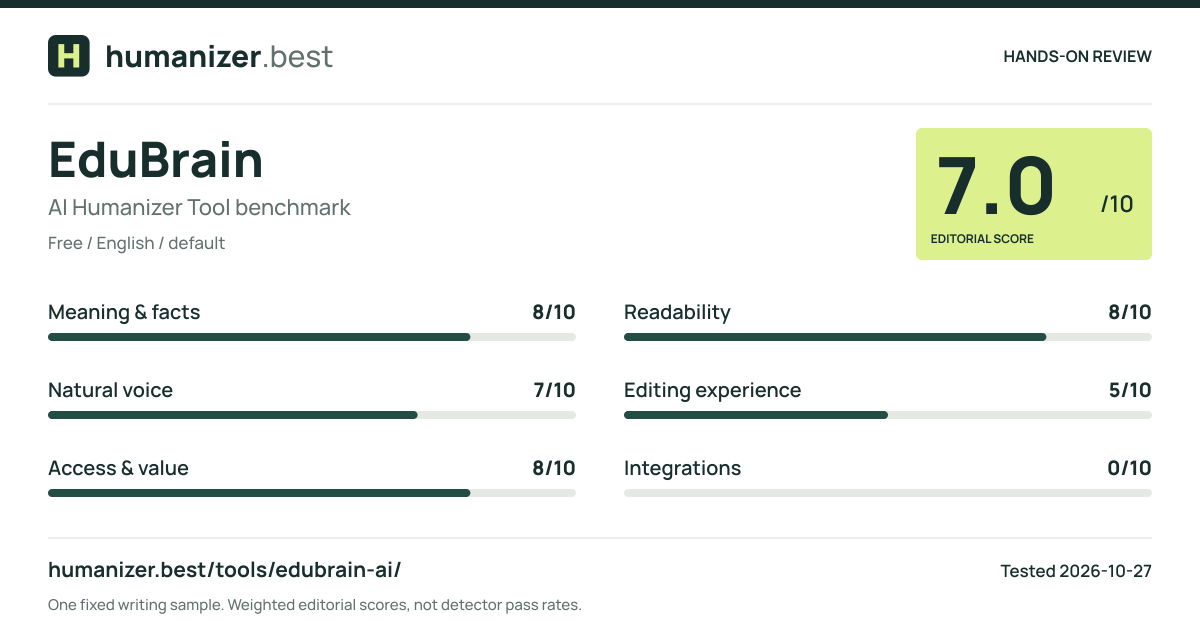
EduBrain kept the main facts and the productivity limitation, but its rewrite made the attendance increase sound causal. Our full free test shows the difference.
The screenshots, complete input and output, feature table and scoring breakdown are on the separate tool profile.
View EduBrain tool details and evidenceA usable rewrite, with a small change in certainty
EduBrain returned a complete rewrite of our library paragraph without asking us to create an account. The result kept the numerical details, the Wednesday closure, the longer Monday and Thursday evenings, and the warning that productivity had not been measured. It also retained the plan to survey residents, examine costs and repeat the trial in winter. That gives a reader much more of the original information than a rewrite that merely sounds polished.
We would still edit one sentence before using it. EduBrain introduced the attendance increase with “This resulted in.” The original reports that visits rose during the experiment; it does not establish that the schedule caused the increase. That difference is easy to overlook because the surrounding paragraph remains sensible. It is also exactly the kind of change our fixed sample is designed to expose.
The result is longer and somewhat more formal than the source. Someone seeking a fuller explanation may prefer it. Someone trying to remove padding from a short update may prefer the original. Our score rewards the details it preserved and the ease of getting a result, while allowing for that stronger causal claim and the extra words.
The test setup
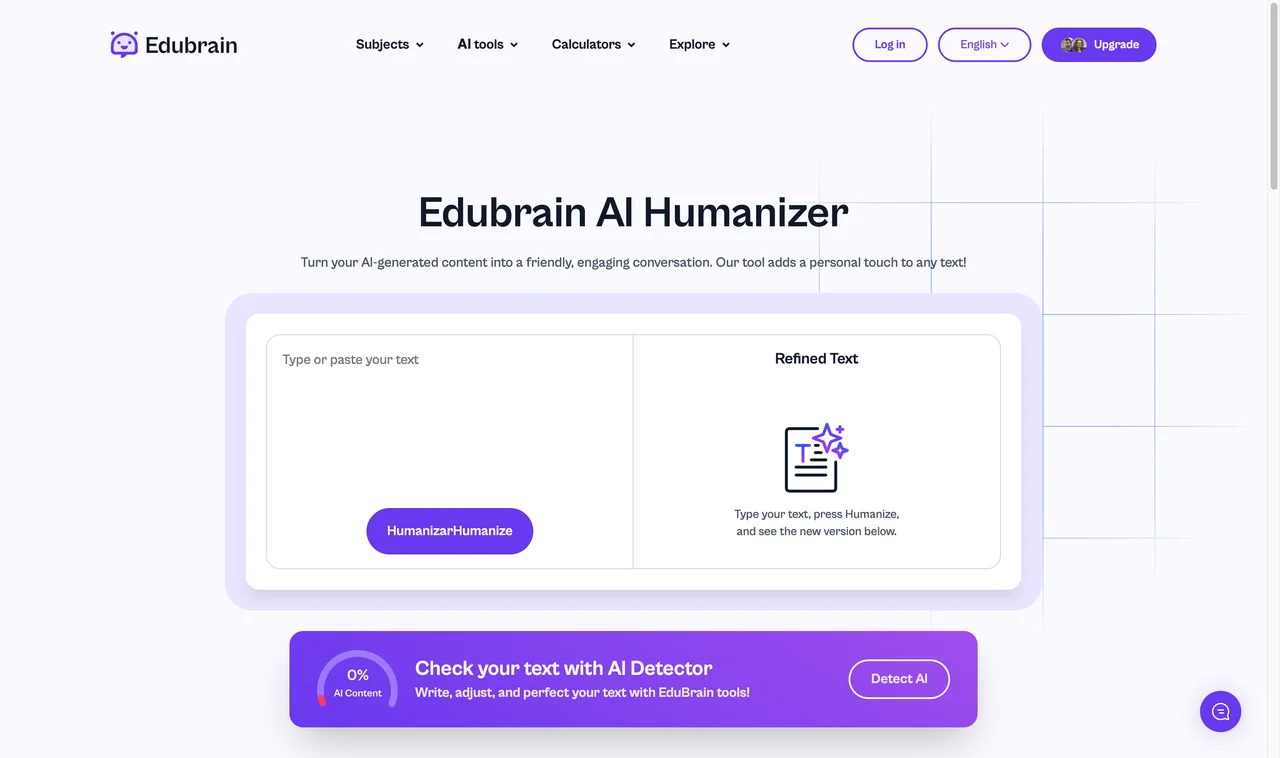
We opened EduBrain's dedicated AI Humanizer page and entered the complete 93-word English benchmark. We used the default workflow and clicked Humanize, without adding an instruction or buying an upgrade. The EduBrain tool profile contains the first output and the input and result screenshots.
The benchmark describes a fictional local library. It is deliberately ordinary: no specialist terminology, citations or emotionally charged language. It contains enough linked facts to make careless rewriting visible. The library changes its opening days but keeps its total hours, receives more visits, and has not measured productivity. A successful rewrite needs to preserve those distinctions.
The rating covers this paragraph and the humanizer controls we used. EduBrain also links to other study and writing tools; we did not test those services or include them in the score.
There is no independent detector result in this review. We judged the text by comparing it with the original and examining the writing. That lets us discuss an observable change in meaning without relying on a product's promise that the output is human-like or undetectable.
Comparing the rewrite with the original
The opening sentence is a reasonable paraphrase. The source's four-day schedule becomes opening for four days a week over a six-week period. It makes the duration explicit and does not invent a place, an institution name or a survey result. The next sentence explains how the weekly total remains at 40 hours, which is essential to understanding the example.
EduBrain also kept both attendance figures in their correct relationship. Visits increase from 1,200 to 1,320 per week. It preserved the inconvenience to Wednesday visitors rather than turning the paragraph into an entirely positive account of the trial. That qualification helps readers understand why higher attendance alone would not settle the decision.
The difficulty is the connection between the schedule and the attendance figures. “This resulted in an increase” presents a causal explanation. Our source gives a sequence of observations. Perhaps the longer evenings caused the increase; perhaps another factor contributed. The passage does not resolve that question. Replacing that introduction with “Weekly visits increased” would retain the useful rewrite without adding certainty.
The staff sentence is stronger. “Productivity levels remained untracked” preserves the original lack of measurement. It does not claim that fewer interruptions made staff more productive. This matters because the two ideas are tempting to combine: an editor might assume that fewer interruptions imply better output. EduBrain resisted that particular inference in the sample we received.
The conclusion also remains qualified. Longer evening hours “could benefit” people with daytime jobs, and the result does not imply that fewer opening days are ideal for every library. The change from the original wording about proof to a statement about what the trial suggests is acceptable in context, although a writer who needs precise research language might retain the original phrasing.
The planned follow-up survives intact. EduBrain includes resident feedback, cost evaluation and another winter trial. Travel patterns “might change,” which preserves uncertainty about the season. It does not decide that people travel more or less. These details are part of the reasoning behind another trial, rather than optional decoration.
Readability and tone
The rewrite is easy to understand on a first read. It uses complete sentences, normal punctuation and coherent references to the library and its staff. We did not find an invented city, a broken number or an obviously malformed sentence in this output. Those are basic expectations, but meeting them matters more than substituting unusual words.
Some choices are more verbose than necessary. “Over a six-week period” is longer than “for six weeks.” “Maintained 40 hours of operation weekly” sounds more administrative than “kept the same 40 weekly opening hours.” Neither phrase is wrong. Both show that the tool leans toward expansion rather than compression in this example.
“Individuals who have jobs during the day” is another case. It expresses the same idea as “people who work during the day” with more words. The rewrite also uses “evaluate cost implications,” where “compare costs” would do. A person editing a newsletter for quick reading could simplify those phrases without losing information.
For a formal report, the expanded phrasing may be acceptable. For a short web announcement, it adds words a reader can do without. EduBrain returned 126 words from our 93-word source, so an editor working to a tight limit would still need to cut it down.
We would keep the accurate structure and make a small manual edit rather than regenerate the whole paragraph. That would address the causal wording and trim a few expanded phrases. Regeneration might produce a different result, but we did not run repeated attempts to find a more favorable example for this review.
How much help does the editor provide?
The page presents a simple input-to-output workflow. There is a text field, a Humanize action and a Refined Text result with a Copy button. We could obtain the complete output without navigating through a setup questionnaire. For a first-time visitor with a short paragraph, the starting point was clear.
The result remains available on the page, so a user can compare it with the input. We did not observe a word-by-word diff or a separate line-highlighting interface in the tested flow. Two blocks of text are helpful, but they still leave the comparison work to the reader. A changed connecting phrase such as “This resulted in” can be difficult to notice when the numbers all look right.
We also did not establish an inline sentence-rewrite control. The demonstrated action rewrites the full input. If a single sentence bothers you, copying the result into an editor and changing that sentence yourself may be the most predictable next step. We do not award a sentence-editing feature merely because the output contains separate sentences.
A Detect AI link appears near the result. We did not use it as an independent quality check. The presence of a detector link tells you that another workflow is available; it does not show whether the humanizer's current output would receive a particular score, or whether that score would be meaningful for your use case.
The interface also showed a cookie preference dialog and an upgrade promotion during the session. Those did not prevent us from obtaining the benchmark output. They are worth mentioning as part of the actual experience, because a screenshot of the clean input alone would not capture every interruption a visitor might encounter.
Free access and pricing limits
Our test cost nothing and did not require registration. That is the strongest pricing fact we can independently establish from the session. The public humanizer page describes the tool as free, and the workflow allowed our entire paragraph to run. The Free and No signup tags on this review refer to that completed test.
The official pricing page lists a Free plan at $0 per week, with advertising and access to all AI tools. It describes use as unlimited. Our completed request verifies the practical free entry point; the wider allowance is the plan's published description, rather than a stress test of repeated usage.
AI-Plus was displayed at $3.99 per week. The listed benefits include an ad-free experience for named tools, advanced reasoning and discounts on expert reviews. The pricing page's explicit ad-free list names several tools, but does not single out the humanizer. We would confirm the exact humanizer benefit before buying AI-Plus specifically for rewriting.
Weekly billing deserves attention when comparing it with monthly subscriptions elsewhere. Four weekly charges total $15.96, but four weeks is only 28 days. Over a full 52-week year, $3.99 per week would total $207.48 if the price remained unchanged and the subscription remained active. Those are arithmetic comparisons, not a quote for an annual plan or a prediction of your final charge.
The page also lists expert help starting at $3.99 for services such as writing assistance and editing. That is a separate offering from the free automated rewrite demonstrated here. A price attached to expert assistance should not be presented as the cost of running this humanizer.
This leaves EduBrain with useful free access and a published broader subscription price. We have not verified a maximum input length or every operational limit that might apply to repeated requests. Our sample was short enough to run without encountering either an input warning or a payment request.
No subscription was purchased for this review. We have not compared free and paid humanizer output. The existence of AI-Plus does not establish that paying would remove the causal wording in the result shown here. The sensible first step is to evaluate the free result, then check whether the specific paid benefits meet a separate need.
API, MCP and agent skills
We did not verify an official humanizer API, MCP server or downloadable agent skill in the public product material we reviewed. EduBrain therefore has none of those verified-integration tags in this comparison. Its integration score reflects that evidence threshold.
This does not establish that no private integration exists. It means we cannot point a reader to a sufficiently documented official capability and say that it supports this humanizer. We distinguish that uncertainty from the capabilities we directly observed in the browser.
Someone looking for automated rewriting would therefore need further evidence before choosing EduBrain. We have a working browser example to inspect, but no documented humanizer request or response to recommend to a developer.
What the score is useful for
EduBrain's strongest result in this comparison is factual retention. It keeps the original schedule, attendance figures, productivity limitation and follow-up plan. The output is readable enough to inspect and reuse after a targeted edit. Those strengths earn most of its points.
The lower editing and integration scores describe the surrounding workflow. We did not observe detailed change tracking or verify developer access. They do not mean that the generated paragraph is unusable. Separating the dimensions lets you decide whether those features matter to your work instead of treating the overall number as a universal verdict.
The causal phrase is the main reason we stop short of a top fidelity score. A humanizer can preserve every number and still change the meaning between them. That is a useful distinction for anyone editing reports, research summaries or operational updates: check the verbs and connecting phrases along with the names and quantities.
For a short English rewrite, EduBrain gave us a coherent free draft with a manageable repair: remove the causal claim, then trim the longer phrases. We would keep the original's wording wherever the expansion adds no explanation. Long documents and automated use remain outside this test.
Sources and test scope
- Official AI Humanizer editor and product information · checked 2026-10-27
- Official subscription plans and weekly billing · checked 2026-10-27
One English paragraph in the free default workflow. Paid modes, external detectors, long documents and developer integrations were not tested. AI-Plus benefits for this particular humanizer were not tested.